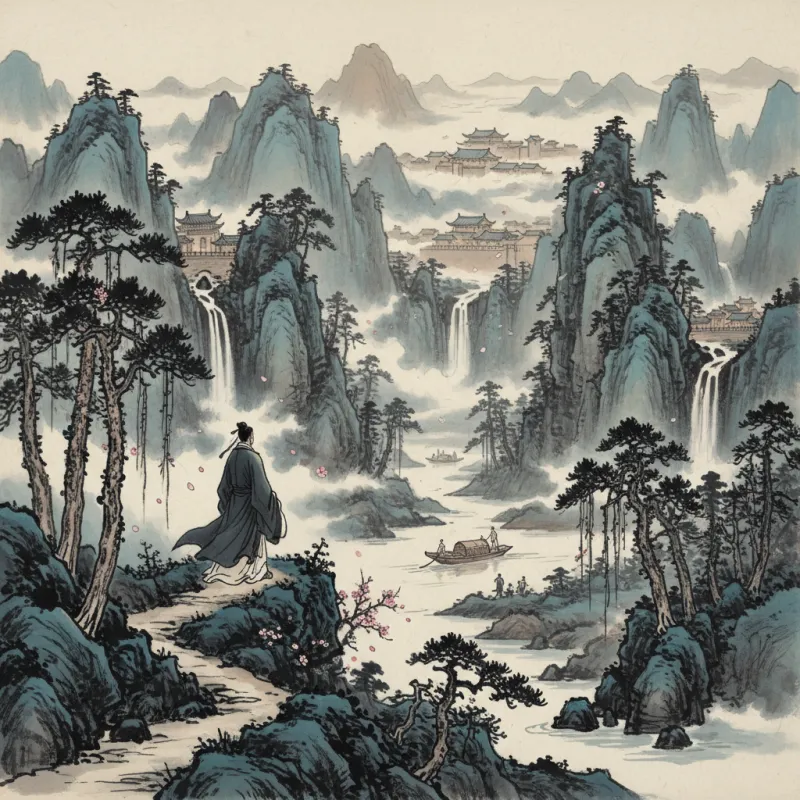
The poet Du Fu stood on a riverbank in 759 AD, watching the current carry away fallen blossoms while government soldiers hunted him through the countryside. He had criticized the emperor's military campaigns, and now everything he knew—his home, his position, his family's safety—hung in the balance. From this moment of terror and displacement, he would write some of Chinese literature's most enduring verses about exile. The melancholy of banishment wasn't just a theme for Tang, Song, and Yuan poets—it was the crucible that transformed their art.
When Distance Becomes Poetry
Exile in imperial China meant more than physical displacement. When a scholar-official fell from grace, he lost his identity. The Confucian system tied a man's worth to his service to the state, so banishment severed him from purpose itself. The exiled poet became a ghost haunting the margins of civilization, and this liminal state produced a particular kind of clarity.
Li Bai (李白, Lǐ Bái, 701-762), the "Immortal Poet," experienced this severance multiple times. After being expelled from the imperial court in 744, he wandered for years, writing poems that transformed geographical distance into emotional landscapes. His "Quiet Night Thought" (静夜思, Jìng Yè Sī) captures exile's essence in just twenty characters—moonlight on the floor becomes frost, triggering homesickness so acute it physically bends the speaker's head downward. The poem's genius lies in its compression: exile isn't explained, it's embodied in that involuntary gesture of looking down, then up at the moon, then down again toward an unreachable home.
What distinguishes Tang exile poetry from earlier traditions is this physicality. The poets didn't just describe longing—they mapped it onto bodies and landscapes. Du Fu's "Spring View" (春望, Chūn Wàng), written while Chang'an burned during the An Lushan Rebellion, famously declares that "the nation is broken, but mountains and rivers remain." The poet's hair turns white from worry; he scratches his head and finds his hairpin barely holds. Exile ages you, literally.
The Song Dynasty's Interior Exile
By the Song dynasty (960-1279), exile had evolved into something more psychological. The political landscape had shifted—scholar-officials now faced factional struggles within an increasingly bureaucratic system. Banishment often meant reassignment to remote posts rather than outright expulsion, but the emotional toll remained devastating.
Su Shi (苏轼, Sū Shì, 1037-1101) spent years in exile, bounced between provincial posts after offending reformist officials. His response was to develop what we might call an aesthetics of displacement. In "Remembering the Past at Red Cliff" (念奴娇·赤壁怀古, Niàn Nú Jiāo: Chìbì Huáigǔ), he stands at a historical battlefield and contemplates the futility of ambition. The poem's power comes from its layering—Su Shi is exiled, contemplating ancient warriors who are themselves now dust, while the river flows eternally indifferent. Exile becomes a lens for viewing all human striving as temporary.
Song poets developed the ci (词, cí) form—lyric poetry set to music—into a vehicle for expressing exile's nuances. Li Qingzhao (李清照, Lǐ Qīngzhào, 1084-1155), though not formally exiled, experienced displacement when the Jin invasion forced her to flee south. Her later ci poems capture a specifically feminine experience of exile: the loss not just of place but of the domestic sphere where women's lives unfolded. In "Slow Slow Song" (声声慢, Shēng Shēng Màn), she piles up words describing emptiness—"seeking, seeking, cold, cold, clear, clear, sad, sad, grieved, grieved." The repetition mimics the obsessive circling of a mind trapped in loss.
The Song poets understood something crucial: you could be exiled while remaining physically in place. The inner landscape of displacement became as important as geographical distance.
Yuan Dynasty: Exile as Identity
The Mongol conquest that established the Yuan dynasty (1271-1368) created a different kind of exile—one based on ethnic and cultural displacement. Chinese scholar-officials found themselves marginalized in their own land, their traditional paths to power blocked by foreign rulers who distrusted them.
This produced a generation of poets for whom exile wasn't an interruption of normal life but the defining condition of existence. Ma Zhiyuan (马致远, Mǎ Zhìyuǎn, c. 1250-1321) wrote sanqu (散曲, sǎnqǔ)—a freer poetic form that emerged during the Yuan—that treated displacement as permanent. His famous "Autumn Thoughts" (天净沙·秋思, Tiān Jìng Shā: Qiū Sī) presents a traveler at dusk encountering a series of images: withered vines, old trees, crows at dusk, a small bridge, flowing water, someone's home, an ancient road, west wind, a thin horse. The final line delivers the punch: "The sun sets in the west, and the heartbroken person is at the edge of the world."
What's revolutionary here is the absence of any hope for return. Tang and Song exile poetry often contained the implicit promise that political fortunes might change, that the emperor might relent. Yuan exile poetry accepts permanent displacement. The "heartbroken person" isn't traveling toward anything—he's simply at the edge, and that's where he'll remain.
The Poetics of Longing
Across these three dynasties, certain images recur with almost talismanic power. The moon appears constantly, that universal symbol of separation—you and your loved ones can see the same moon, but you cannot touch. Wild geese flying south trigger memories because they're migrating home while the poet cannot. Willow branches, traditionally given as parting gifts, become shorthand for separation's pain.
But the real innovation of exile poetry lies in its treatment of time. Exiled poets developed techniques for collapsing past and present, creating a temporal vertigo that mirrors displacement's disorientation. When Du Fu writes "I remember when we first met," he's not just recalling—he's superimposing that memory onto his present suffering, making both times equally real and equally painful.
The temporal dimensions of exile deserve more attention than they typically receive. These poets weren't simply nostalgic; they were experimenting with how consciousness experiences time when severed from place.
Why Exile Produced Great Poetry
There's a paradox at the heart of Chinese exile poetry: banishment, meant as punishment, became the condition for artistic achievement. Why? Several factors converged.
First, exile provided distance—literal and metaphorical—from the court's stifling conventions. Away from the capital's literary circles and their expectations, poets could experiment. Li Bai's wildest, most imaginative poems came from his wandering years. Su Shi developed his distinctive voice only after exile forced him to abandon his early, more conventional style.
Second, suffering clarified. The comfortable court poet might write elegant verses about spring blossoms, but the exiled poet, watching those same blossoms fall while separated from family, understood impermanence in his bones. Exile made abstract Buddhist and Daoist concepts about attachment and loss viscerally real.
Third, exile created audience. The poems resonated because so many scholar-officials experienced banishment. These weren't obscure personal complaints—they articulated a shared trauma. When you read Du Fu's exile poems, you're reading the voice of an entire class of educated men who knew their careers could end with one political miscalculation.
The Legacy of Melancholy
The exile poetry of the Tang, Song, and Yuan dynasties established templates that Chinese poets would use for centuries. Even today, when Chinese writers discuss displacement—whether political exile, economic migration, or the diaspora experience—they reach for these classical images and structures.
But we should resist romanticizing this tradition. Exile destroyed lives. Du Fu died in poverty, still displaced. Li Bai drowned (according to legend) while drunkenly trying to embrace the moon's reflection—a fitting end for a poet obsessed with unattainable beauty, but a tragedy nonetheless. The poems are magnificent, but they document real suffering.
What makes this poetry endure isn't just its aesthetic achievement but its emotional honesty. These poets refused to prettify their pain or pretend that exile was a spiritual opportunity. Yes, they found meaning in displacement, but they never stopped insisting that it hurt. Li Qingzhao's repeated "cold, cold, clear, clear, sad, sad" doesn't transcend grief—it inhabits it completely.
The melancholy of exile in Chinese classical poetry isn't a mood or a theme—it's a way of seeing. Once you've been severed from home, you notice all the world's separations: seasons changing, friends parting, dynasties falling, rivers flowing toward seas they'll never return from. The exiled poet becomes attuned to impermanence itself. And in that attunement, paradoxically, they create something permanent: poems that still speak across centuries to anyone who has ever felt displaced, anyone who has ever looked at the moon and thought of home.
Related Reading
- Political Poetry: When Poets Challenged Emperors
- Exile Poetry: When Banishment Produced China's Greatest Literature
- Su Shi in Exile: How Banishment Produced China's Greatest Prose
- Su Shi in Exile: Making the Best of Banishment
- Qu Yuan: The First Named Poet in Chinese History
- The Timeless Art of Song Poets: A Deep Dive into Classical Chinese Poetry
- Drinking Poetry: Wine, Moonlight, and the Art of Getting Drunk with Purpose
- Love Poetry in Classical Chinese: The Art of Saying Everything by Saying Almost Nothing
Explore Chinese Culture
- Explore the Tang dynasty's golden age
- Explore Daoist themes in classical poetry
- Explore Chinese literary traditions