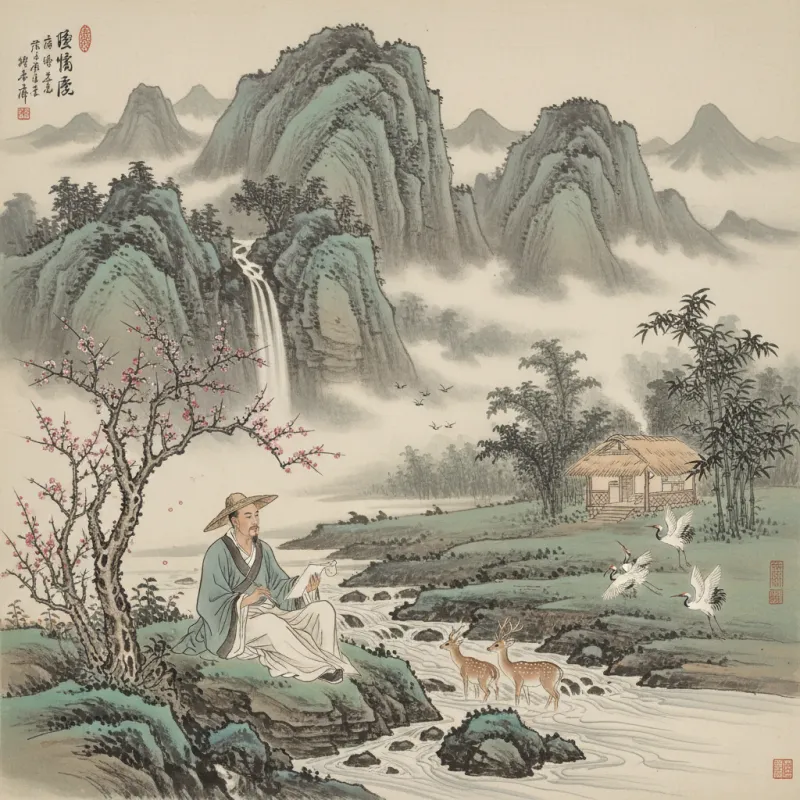
Picture this: It's 1080, and one of China's most celebrated poets is standing in a prison cell, awaiting execution. His crime? Writing poems that mocked the emperor's policies. The punishment? Death by a thousand cuts seemed likely. But at the last moment, the emperor commuted his sentence to exile instead. Su Shi (苏轼, Sū Shì, 1037–1101) walked out of that cell and into what would become one of the most productive periods of creative output in Chinese literary history. Most people would have spent their exile nursing grievances and plotting revenge. Su Shi? He invented a pork dish, befriended monks, and wrote poetry so good that even his political enemies had to admit it was brilliant.
The First Exile: Huangzhou and the Birth of Dongpo
When Su Shi arrived in Huangzhou (黄州, Huángzhōu) in 1080, he was 43 years old and professionally ruined. The "Crow Terrace Poetry Case" (乌台诗案, Wūtái Shī'àn) had nearly cost him his life — court officials had combed through his poems looking for seditious content, and they'd found plenty of double meanings to prosecute. The New Policies faction, led by Wang Anshi, wanted him silenced permanently.
Huangzhou was a backwater town on the Yangtze River, the kind of place where nothing happened and nobody important ever visited. Perfect for a disgraced official. Except Su Shi refused to act disgraced. The local magistrate, taking pity on him, gave him a plot of land on the eastern slope outside town. Su Shi named himself "Dongpo Jushi" (东坡居士, Dōngpō Jūshì) — the Layman of the Eastern Slope — and set about farming it himself.
This wasn't gentleman farming. Su Shi actually worked the land, getting his hands dirty, learning from local farmers. He wrote about it constantly, turning agricultural labor into poetry. His "Record of the Eastern Slope" (东坡志林, Dōngpō Zhìlín) documents everything from planting techniques to the proper way to brew wine from rice. When he couldn't afford meat, he experimented with cooking cheap cuts of pork belly in wine and soy sauce until they were tender enough to fall apart. The result? Dongpo pork (东坡肉, Dōngpō Ròu), still served in Chinese restaurants worldwide.
But the real masterpiece from this period was "Rhapsody on the Red Cliffs" (赤壁赋, Chìbì Fù), written in 1082. Su Shi and some friends took a boat trip to Red Cliffs, the site of a famous Three Kingdoms battle. Standing there at night, looking at the moon reflected in the Yangtze, Su Shi wrote one of the most philosophically profound pieces in Chinese literature. The rhapsody meditates on impermanence, the smallness of human life against the vastness of nature, and somehow manages to be both melancholy and joyful at the same time. It's the work of someone who's looked death in the face and decided that the proper response is to appreciate the moon while you can.
The Philosophy of Exile: Buddhism, Daoism, and Not Giving a Damn
Su Shi's response to exile wasn't just practical — it was deeply philosophical. He'd been studying Buddhism and Daoism for years, but exile gave him the chance to actually live those philosophies rather than just write about them.
From Buddhism, he took the concept of non-attachment. If you're not attached to status, wealth, or comfort, then losing them doesn't hurt. His poem "Calming the Waves" (定风波, Dìng Fēng Bō) captures this perfectly. Written after getting caught in a rainstorm without an umbrella, it ends with the lines: "Returning home, the rain has passed, the sky cleared / It matters not whether there was wind or rain." The poem isn't really about weather — it's about maintaining equanimity whether you're at court or in exile, whether you're praised or condemned.
From Daoism, he took the idea of going with the flow, of finding freedom in accepting what you cannot change. The Daoist concept of "wuwei" (无为, wúwéi) — effortless action, or non-forcing — shows up constantly in his exile writings. He doesn't rage against his circumstances; he adapts to them so completely that exile stops being exile and becomes just... life.
But Su Shi wasn't a saint or a sage sitting in meditation all day. He was a man who loved good food, good wine, and good company. His Buddhism and Daoism were practical, lived philosophies, not abstract theories. When he couldn't afford expensive ingredients, he learned to cook with what was available. When he couldn't socialize with officials, he made friends with farmers and fishermen. When he couldn't practice calligraphy on expensive paper, he practiced on bamboo and stone.
This combination of high philosophy and practical living is what makes Su Shi's exile poetry so compelling. He's not writing from an ivory tower about how to handle adversity — he's writing from the middle of adversity itself, and somehow making it look easy.
The Second Exile: Huizhou and the Lychee Poems
Just when Su Shi had settled into a comfortable life back at court, politics struck again. In 1094, at age 57, he was exiled to Huizhou (惠州, Huìzhōu) in Guangdong province. This was serious — Huizhou was deep in the subtropical south, hot, humid, and full of diseases that northerners had no immunity to. Many exiles died there.
Su Shi's response? He discovered lychees. His poem "Eating Lychees" (食荔枝, Shí Lìzhī) contains the famous lines: "I eat three hundred lychees a day / And don't mind being a Lingnan man forever." Lingnan (岭南, Lǐngnán) was the region south of the mountains, considered barbarous and uncivilized by northern Chinese standards. Su Shi was essentially saying: "This place is great, actually. Have you tried the fruit?"
This wasn't just bravado. Su Shi genuinely seems to have enjoyed Huizhou. He studied the local dialect, learned about regional customs, and wrote extensively about the landscape and people. His "Huizhou Writings" (惠州文集, Huìzhōu Wénjí) show a man deeply engaged with his surroundings rather than pining for the capital.
He also continued his Buddhist studies, becoming close friends with several local monks. One of them, Foyin (佛印, Fóyìn), appears in numerous anecdotes about Su Shi. In one famous story, Su Shi wrote a poem claiming he was as immovable as a mountain in meditation. Foyin wrote back: "You say you're like a mountain, but one fart from me could blow you across the river." Su Shi's response? He laughed so hard he nearly fell over. This is the kind of Buddhism Su Shi practiced — irreverent, humorous, and deeply human.
The Third Exile: Hainan and the Edge of the World
In 1097, at age 60, Su Shi was exiled again — this time to Hainan Island (海南, Hǎinán). In the Song Dynasty, Hainan was barely considered part of China. It was hot, malarial, and populated mostly by indigenous Li people who spoke languages incomprehensible to Chinese speakers. Exiles sent to Hainan rarely returned alive.
Su Shi's friends assumed they'd never see him again. He probably assumed the same. But instead of giving up, he threw himself into life on Hainan with the same enthusiasm he'd shown everywhere else. He built a house, planted a garden, and started teaching local children to read and write. He studied Li culture and language. He experimented with local foods and medicines. He wrote constantly.
His poetry from this period has a different quality — more reflective, more aware of mortality, but not morbid. There's a sense of someone taking stock of their life and finding it, on balance, pretty good. His poem "Crossing the Sea on the Night of June 20th" (六月二十日夜渡海, Liù Yuè Èrshí Rì Yè Dù Hǎi) describes the journey to Hainan with vivid imagery: "Bitter, bitter the taste of the sea / Vast, vast the expanse of the sky." But it ends with acceptance rather than despair.
What's remarkable is that Su Shi's reputation actually grew during his Hainan exile. His poetry circulated throughout China, copied and recopied by admirers. Even his political enemies had to acknowledge his literary genius. By the time he was finally pardoned in 1100, he'd become a legend — the poet who couldn't be broken, no matter how far you sent him.
The Art of Making Friends in Exile
One of Su Shi's greatest talents was making friends wherever he went. This wasn't just a personality trait — it was a survival strategy. In exile, cut off from official support networks, you needed local allies. Su Shi cultivated them brilliantly.
In Huangzhou, he befriended farmers who taught him agriculture. In Huizhou, he befriended monks who deepened his Buddhist practice. In Hainan, he befriended local scholars and even some of the indigenous Li people. He wrote poems for them, taught their children, shared meals with them. He treated everyone — regardless of social status — with genuine respect and interest.
This wasn't condescension or slumming. Su Shi genuinely believed that wisdom could be found anywhere, in anyone. His writings are full of conversations with farmers, fishermen, and monks that reveal profound insights. He quotes them, learns from them, and immortalizes them in his poetry. Compare this to other exiled officials who spent their time complaining about the lack of cultured company, and you see why Su Shi thrived where others merely survived.
His friendship with the monk Foyin is particularly telling. They met during Su Shi's first exile and remained close for decades. Their relationship was built on mutual teasing, philosophical debates, and genuine affection. When Su Shi was exiled to Hainan, Foyin sent him letters and gifts. When Foyin died, Su Shi wrote a moving eulogy. This pattern repeated with dozens of people across all three exiles — Su Shi built genuine relationships that sustained him emotionally and practically.
The Legacy: How Exile Made Su Shi Immortal
Here's the paradox: Su Shi's political enemies succeeded in destroying his career, but they accidentally made him immortal. If he'd stayed at court, he would have been just another talented official, writing occasional poems between administrative duties. Exile gave him time, motivation, and material for his greatest works.
The poetry he wrote in exile is more personal, more philosophical, and more emotionally resonant than anything he wrote at court. "Rhapsody on the Red Cliffs" alone would secure his place in Chinese literary history. Add in "Calming the Waves," the lychee poems, the Hainan writings, and dozens of other masterpieces, and you have a body of work that defined what exile poetry could be.
Su Shi also created a template for how to handle adversity that influenced Chinese culture for centuries. The idea that exile could be an opportunity rather than just a punishment, that you could find meaning and joy even in difficult circumstances — this became a recurring theme in Chinese literature and philosophy. Later poets like Huang Tingjian explicitly modeled their response to exile on Su Shi's example.
Even his culinary legacy endures. Dongpo pork is still served in restaurants across China and in Chinese communities worldwide. Every time someone orders it, they're participating in a tradition that started with a disgraced official making the best of a bad situation in a backwater town on the Yangtze.
What Su Shi Teaches Us About Resilience
Su Shi's exile story isn't just historical curiosity — it's a masterclass in resilience. Not the grit-your-teeth-and-endure kind of resilience, but something more subtle and sustainable. He didn't just survive exile; he transformed it into something productive and meaningful.
First, he refused to let external circumstances define his internal state. He couldn't control being exiled, but he could control how he responded. This isn't just positive thinking — it's a fundamental reorientation of what matters. Status, position, wealth — all the things that seemed so important at court — turned out to be optional. What remained was his ability to write, think, make friends, and appreciate beauty.
Second, he stayed curious. Instead of retreating into bitterness, he engaged with his surroundings. He learned new things — farming techniques, local dialects, regional cuisines, indigenous cultures. This curiosity kept him intellectually alive and gave him material for his writing. It also made him genuinely interesting to the people around him, which helped him build the social networks he needed to survive.
Third, he maintained his sense of humor. The lychee poem isn't just about fruit — it's a joke at his own expense and at the expense of the officials who exiled him. "You sent me to this terrible place? Joke's on you — I love it here!" This ability to laugh at adversity, to find absurdity in suffering, kept him from drowning in self-pity.
Finally, he created. He didn't just passively endure exile — he actively used it as material for art. Every hardship became a poem, every new experience became an essay. This transformed suffering into meaning, which is perhaps the most powerful form of resilience there is.
The Final Return and Death
In 1100, after three years on Hainan, Su Shi was finally pardoned. He was 63 years old, exhausted, and sick. The journey back north was grueling. He made it as far as Changzhou (常州, Chángzhōu) in Jiangsu province before his health gave out completely. He died there in July 1101, just months after his pardon.
His last poem, written on his deathbed, was characteristically philosophical and surprisingly cheerful. He wrote about the impermanence of life, the foolishness of clinging to anything, and the beauty of letting go. Even at the end, he refused to be bitter about the years lost to exile or the career that never recovered.
The irony is that Su Shi's exile — meant to silence and punish him — actually amplified his voice across centuries. His court poetry is competent but conventional. His exile poetry is transcendent. The officials who banished him are remembered only as footnotes in his biography. Su Shi himself is remembered as one of the greatest poets in Chinese history, a man who turned banishment into art and adversity into wisdom.
When you read Su Shi's exile poetry today, what strikes you isn't the suffering — it's the joy. The joy of discovering lychees, of watching the moon over the Yangtze, of making friends with farmers and monks, of finding freedom in having nothing left to lose. His enemies took away his position, his wealth, and years of his life. But they couldn't take away his ability to write, to think, to laugh, and to find beauty wherever he was. In the end, that's what made him unbreakable.
Related Reading
- Qu Yuan: The First Named Poet in Chinese History
- Su Shi in Exile: How Banishment Produced China's Greatest Prose
- Exile Poetry: When Banishment Produced China's Greatest Literature
- Political Poetry: When Poets Challenged Emperors
- The Melancholy of Exile: A Journey Through Tang, Song, and Yuan Poetry
- Poetry Drinking Games: When Literature Met Entertainment
- Rediscovering Women Poets of the Tang, Song, and Yuan Dynasties
- Unveiling the Essence of Chinese Classical Poetry: Insights from Tang, Song, and Yuan Poets
Explore Chinese Culture
- Explore the Tang dynasty's golden age
- Explore Daoist themes in classical poetry
- Explore Chinese literary traditions