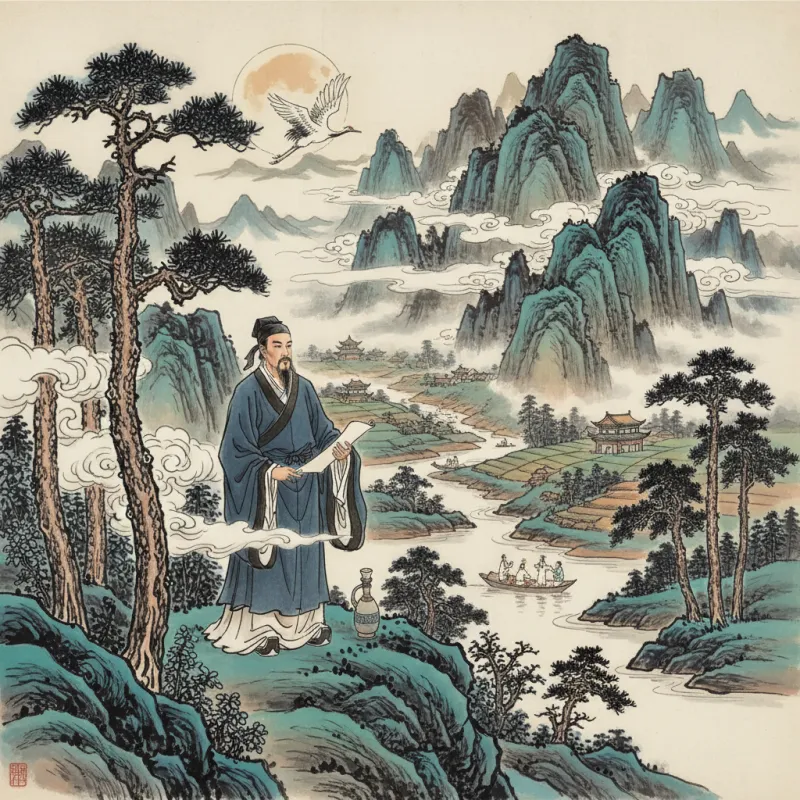
The night Li Bai drowned, he was drunk — as usual — and trying to embrace the moon's reflection in the Yangtze River. Or so the legend goes. The truth is probably more mundane (he likely died of illness), but the fact that this story persists tells you everything about how China remembers its greatest poet. Li Bai (李白 Lǐ Bái, 701–762) didn't just write poetry; he became poetry, a walking embodiment of romantic excess, wine-soaked genius, and the kind of freedom that makes bureaucrats nervous.
His contemporary He Zhizhang (贺知章 Hè Zhīzhāng) called him a "banished immortal" (谪仙人 zhéxiānrén) — a celestial being kicked out of heaven for misbehavior. It's the perfect metaphor. Li Bai wrote as if the normal rules didn't apply to him, because in his mind, they didn't. While Du Fu was perfecting his craft with painstaking precision, Li Bai was getting spectacularly drunk and producing masterpieces that seemed to flow directly from some divine source. Over a thousand of his poems survive, and reading them feels less like studying literature and more like watching someone dance on the edge of a cliff.
The Mystery of His Origins
Li Bai's early life is shrouded in deliberate obscurity, which he seemed to prefer. He was born in 701, probably in Central Asia (modern-day Kyrgyzstan), to a merchant family that relocated to Sichuan when he was five. The "probably" matters here — Li Bai himself was vague about his background, and scholars have been arguing about it for centuries. Some suggest his family were exiled criminals; others think they were wealthy merchants who couldn't hold official positions due to their commercial background.
What we know for certain is that Li Bai grew up in Sichuan, received an excellent education in the Confucian classics, and developed an early obsession with Daoist philosophy and swordplay. Yes, swordplay. The young Li Bai apparently fancied himself a knight-errant (游侠 yóuxiá), wandering the countryside righting wrongs and looking for adventure. This wasn't just youthful posturing — the martial spirit infuses his poetry with an energy that sets him apart from more scholarly poets. When Li Bai writes about mountains, you believe he's actually climbed them, probably while drunk and carrying a sword.
He never took the imperial examinations, that grueling test that determined who got to join the bureaucracy. This was unusual for someone of his education and ambition. Whether this was choice or necessity (merchant families faced restrictions), it meant Li Bai would spend his entire life as an outsider, seeking patronage rather than climbing the official ladder. This outsider status became central to his identity and his art.
The Wandering Years
From his early twenties, Li Bai wandered. And wandered. And wandered some more. He traveled through much of China, visiting famous mountains, drinking with monks and hermits, writing poems, and generally living like someone who'd read too much Daoist philosophy and taken it seriously. The Daoists preached spontaneity, naturalness, and freedom from social constraints — Li Bai made this his entire personality.
During these years, he married (at least twice, possibly three times), had children, and somehow managed to build a reputation as an extraordinary poet despite having no official position. His poetry from this period shows him experimenting with every form available: old-style verse (古体诗 gǔtǐshī), regulated verse (律诗 lǜshī), and especially the jueju (绝句 juéjù), the four-line form he would master. He wrote drinking songs, nature poems, poems about friendship, poems about being far from home, and poems about how much he missed the mountains.
The wandering wasn't just romantic adventure — it was also networking. Li Bai was cultivating connections with influential people, hoping for an introduction to the imperial court. In traditional China, talent alone wasn't enough; you needed someone to recommend you. Li Bai spent years collecting these recommendations like trading cards.
The Brief Glory at Court
In 742, at age 42, Li Bai finally got his break. He was summoned to the capital Chang'an (modern Xi'an) by Emperor Xuanzong (玄宗 Xuánzōng), who had heard about this extraordinary poet. This should have been Li Bai's moment — the validation of decades of wandering and writing. Instead, it became a spectacular disaster that somehow enhanced his legend.
Li Bai was appointed to the Hanlin Academy (翰林院 Hànlín Yuàn), an elite group of scholars and poets who served the emperor. He was supposed to write ceremonial verses and entertain the court with his wit. And he did — brilliantly. His poems from this period show him at the height of his powers, producing works of stunning beauty on demand. The problem was everything else.
The stories from this period are probably exaggerated, but they're too good not to repeat. Li Bai allegedly showed up to court drunk, demanded that the powerful eunuch Gao Lishi (高力士 Gāo Lìshì) remove his boots, and generally behaved like someone who'd forgotten that emperors can have you executed. He wrote poems that subtly criticized court politics and made enemies among the officials who actually ran things. Within two years, he was out — either dismissed or encouraged to leave, depending on which account you believe.
Most people would see this as failure. Li Bai saw it as liberation. He left Chang'an with a generous severance gift from the emperor and went back to wandering, drinking, and writing. The brief court experience gave him material for some of his most famous poems about the corruption of power and the superiority of natural freedom over official glory. As Wang Wei was finding peace in his mountain retreat, Li Bai was turning his rejection into art.
The Poetry of Wine and Moon
Li Bai's relationship with alcohol deserves its own section because it's inseparable from his poetry. He didn't just drink and write — drinking was his creative method, his philosophy, his brand. His poem "Drinking Alone Beneath the Moon" (月下独酌 Yuè Xià Dú Zhuó) perfectly captures this: he's drinking by himself, so he invites the moon and his shadow to join him, creating a party of three. It's playful, lonely, and slightly unhinged — pure Li Bai.
The wine wasn't just about getting drunk (though there was plenty of that). In Chinese literary culture, wine represented freedom from social constraints, spontaneity, and access to deeper truths. When Li Bai writes about drinking, he's writing about a state of consciousness where the artificial boundaries between self and nature dissolve. His most famous drinking poem, "Waking from Drunkenness on a Spring Day" (春日醉起言志 Chūnrì Zuì Qǐ Yán Zhì), asks: "Since life is but a dream, why toil and trouble?" It's the ultimate statement of his philosophy — life is short, beauty is everywhere, and spending it sober in an office is a waste.
The moon appears in his poetry almost as often as wine, and often together. Li Bai's moon isn't the scientific object we know today — it's a companion, a symbol of purity, a reminder of home, and sometimes a drinking partner. His poem "Quiet Night Thought" (静夜思 Jìng Yè Sī) is probably the most famous poem in Chinese — every schoolchild memorizes it. Four lines about seeing moonlight, thinking it's frost, looking up at the moon, and thinking of home. Simple, direct, devastating.
The An Lushan Rebellion and Final Years
In 755, everything changed. The An Lushan Rebellion (安史之乱 Ān Shǐ zhī Luàn) erupted, plunging China into chaos and effectively ending the golden age of Tang poetry. The rebellion was led by An Lushan, a general who had been a favorite of Emperor Xuanzong. It would last eight years, kill millions, and permanently weaken the Tang dynasty.
Li Bai, now in his fifties, made a catastrophic political mistake. He accepted a position with Prince Li Lin (李璘 Lǐ Lín), one of the emperor's sons who was fighting the rebels. Unfortunately, Prince Li Lin also had ambitions of his own and eventually rebelled against his brother, the new emperor. When this rebellion was crushed, Li Bai was arrested and sentenced to exile in Yelang (夜郎 Yèláng), in remote southwestern China.
The exile was eventually commuted — Li Bai was already old and sick, and he had powerful friends who intervened. But the experience marked him. His late poems show a man grappling with mortality, political disillusionment, and the sense that the world he'd known was gone. They're less exuberant than his earlier work, more reflective, though still shot through with his characteristic defiance.
The Immortal Legacy
Li Bai died in 762, probably of illness, though the story about drowning while trying to embrace the moon's reflection is too perfect to abandon completely. He was 61, which was a decent age for the time, especially for someone who'd spent decades drinking heavily and wandering through war-torn provinces.
His influence on Chinese poetry is impossible to overstate. While Du Fu is often considered the greater technical master, Li Bai is the poet everyone loves. His work has been translated more than any other Chinese poet, set to music countless times, and quoted in everything from classical opera to modern pop songs. The "banished immortal" nickname stuck because it captures something essential about his appeal — he wrote as if he were playing by different rules, accessing some source of inspiration unavailable to ordinary mortals.
What makes Li Bai endure isn't just technical brilliance (though he had that). It's the personality that blazes through every line — the refusal to compromise, the celebration of friendship and nature, the conviction that a life of freedom and beauty matters more than official success. In a culture that valued conformity and hierarchy, Li Bai wrote poems about getting drunk and ignoring the emperor. In a literary tradition that prized careful craftsmanship, he made spontaneity look like the highest art.
Reading Li Bai today, over 1,200 years after his death, you still feel that energy — the sense of someone fully alive, fully present, writing exactly what he wanted to write. He's the poet you want to drink with, the friend you want on a mountain hike, the voice reminding you that life is short and the moon is beautiful and sometimes the only reasonable response to existence is to pour another cup of wine and write a poem. The banished immortal indeed — too wild for heaven, too brilliant for earth, and somehow exactly what both needed.
Related Reading
- Bai Juyi: The Song of Everlasting Sorrow
- Li Shangyin: Master of Romantic Ambiguity
- Li Bai vs Du Fu: The Rivalry That Defined Chinese Poetry
- The Great Poets of China: Li Bai, Du Fu, and the Rivalry That Never Was
- Modern Chinese Poetry: From Classical Forms to Free Verse
- Bai Juyi: The People's Poet
- Unveiling the Essence of Chinese Classical Poetry: Insights from Tang, Song, and Yuan Poets
Explore Chinese Culture
- Explore the Tang dynasty's golden age
- Explore Daoist themes in classical poetry
- Explore Chinese literary traditions