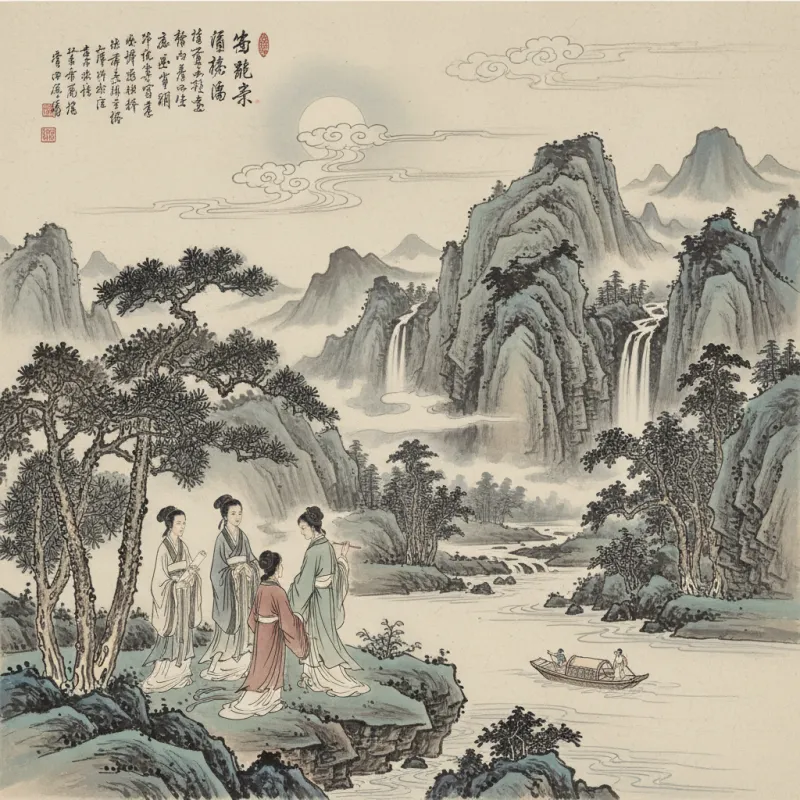
When the Tang Dynasty poet Xue Tao (薛涛, Xuē Tāo) designed her own stationery—delicate pink paper perfectly sized for quatrains—she wasn't just being aesthetic. She was claiming space in a literary world that pretended women didn't exist. That paper, called "Xue Tao jian" (薛濤箋), became so famous that male poets clamored to write on it. Yet for centuries, literary historians barely mentioned her name.
The erasure of women poets from Chinese literary history isn't accidental—it's architectural. When we talk about the "golden age" of Tang poetry, we're usually talking about Du Fu, Li Bai, and Wang Wei. When we discuss Song Dynasty ci poetry (詞, cí), we mean Su Shi and Xin Qiji. The canon was built by men, for men, and women poets were relegated to footnotes, if they appeared at all. But the manuscripts tell a different story. Hundreds of women wrote, circulated their work, and influenced the literary culture of their time. We just stopped listening.
The Tang Dynasty: Writing Against Invisibility
The Tang Dynasty produced at least 130 documented women poets, though scholars estimate hundreds more whose work has been lost. These weren't dilettantes dabbling in verse—they were serious artists working within and against the constraints of their era.
Xue Tao stands out not just for her technical mastery but for her professional audacity. A courtesan in Chengdu, she corresponded with the major poets of her day as an equal. Her poem "Sending a Friend Off" demonstrates the compressed power of her style: four lines that contain an entire philosophy of departure and memory. She wrote in the masculine voice, adopting the persona of the scholar-official, and nobody questioned whether she had earned that right. Her contemporaries didn't—they recognized her genius.
Yu Xuanji (魚玄機, Yú Xuánjī) took a different path. A Daoist nun who ran her own salon in Chang'an, she wrote with a directness about female desire that still feels radical. Her poem "Selling Peonies" isn't really about flowers—it's about the commodification of beauty, the transaction of courtship, the way women's bodies become currency. She was executed at 27 for allegedly murdering a maid, and immediately her poetry became scandalous, dangerous, unfit for proper anthologies. Which is exactly why it matters.
The courtesan-poets of the Tang deserve special attention because they occupied a unique social position. Excluded from the examination system and respectable marriage, they created an alternative literary culture. They had education, leisure, and motivation to write. They also had audiences—the male literati who visited them weren't just seeking entertainment, they were seeking conversation, criticism, and collaboration. This parallel literary world has been systematically undervalued, as if poetry written in pleasure quarters somehow counts less than poetry written in government offices.
The Song Dynasty: Refinement and Restriction
The Song Dynasty brought contradictions. On one hand, the rise of Neo-Confucianism tightened restrictions on women's behavior, emphasizing female virtue, seclusion, and subordination. On the other hand, the explosion of ci poetry—lyric songs set to popular melodies—created new opportunities for women's voices.
Li Qingzhao (李清照, Lǐ Qīngzhào) is the exception that proves the rule. She's the one woman poet everyone knows, the token female in the canon. But her inclusion has been sanitized. Anthologies love her early poems about domestic happiness and wine-drinking, her playful scenes of married life. They're less enthusiastic about her later work—the bitter poems after her husband's death, her remarriage and divorce, her fierce criticism of male scholars who got history wrong. Li Qingzhao wasn't just a talented woman who wrote pretty verses. She was a literary critic, a historian, and a theorist who wrote essays on ci poetics that male scholars still cite.
What's fascinating about Li Qingzhao is how she weaponized the language of feminine weakness. Her most famous line—"This time, what a word 'sorrow' can do?" (這次第,怎一個愁字了得, zhè cì dì, zěn yī gè chóu zì liǎo dé)—seems to embody delicate female melancholy. But read in context, it's a devastating critique of language itself, of how words fail to contain experience. She's not performing sadness; she's interrogating the entire poetic tradition.
Zhu Shuzhen (朱淑真, Zhū Shūzhēn) offers a darker counterpoint. Trapped in an unhappy marriage, she wrote poems of such raw longing and frustration that her family burned most of her work after her death. What survives—about 300 poems—reveals a woman suffocating under social expectations. Her poem "Autumn Night" doesn't just describe loneliness; it anatomizes it, showing how isolation becomes a physical presence in the room. The Song Dynasty gave women like Zhu Shuzhen the education to write but not the freedom to live. That tension runs through every line.
The Yuan Dynasty: Mongol Rule and Literary Freedom
The Mongol conquest that established the Yuan Dynasty disrupted everything, including gender norms. With the examination system suspended and traditional Confucian hierarchies destabilized, some women found unexpected opportunities. The courtesan culture flourished again, and with it, women's poetry.
Guan Daosheng (管道昇, Guǎn Dàoshēng) represents a different model entirely—the respectable wife who was also a recognized artist. Married to the famous painter and calligrapher Zhao Mengfu, she was herself an accomplished painter and poet. Her "Bamboo Poem" circulated widely, and her calligraphy was collected by connoisseurs. What's remarkable is that she achieved this recognition within marriage, not outside it. The Yuan Dynasty's cultural fluidity allowed for possibilities that the Song Dynasty's rigid Neo-Confucianism had foreclosed.
The Yuan Dynasty also saw the rise of sanqu (散曲, sǎnqǔ), a freer verse form associated with drama and popular entertainment. Women wrote sanqu, performed it, and shaped its development. This popular literary culture—less prestigious than classical poetry, more accessible, more performative—gave women poets a different kind of platform. It's no coincidence that as we move toward more "vulgar" genres, we find more women's voices. The canon excluded them, so they built their own traditions.
The Problem of Attribution and Recovery
Here's the uncomfortable truth: we don't know how many women poets we've lost. Manuscripts were destroyed by families ashamed of literary daughters. Works were attributed to male poets because that made them more valuable. Collections were dismissed as "women's writing" and excluded from major anthologies. The 20th-century scholar Hu Wenkai spent decades compiling a biographical dictionary of Chinese women writers and found over 4,000 names. Most of them, we have only names—no surviving work, no biographical details, just evidence that they existed and wrote.
The recovery project is ongoing and contentious. Some scholars argue for separate anthologies of women's poetry, creating space for voices that the mainstream canon excludes. Others worry this ghettoizes women's work, suggesting it can't compete in the major leagues. Both positions have merit, and both miss something crucial: the canon itself is the problem. It was never neutral, never just about "quality." It was always about power—who gets to speak, who gets remembered, whose voice counts as universal rather than particular.
Modern readers sometimes approach women's poetry from the Tang, Song, and Yuan dynasties looking for proto-feminism, for evidence of resistance and rebellion. Sometimes we find it—Yu Xuanji's erotic directness, Li Qingzhao's intellectual authority, Zhu Shuzhen's barely contained rage. But we also find women working within the system, writing conventional poems about conventional subjects, and that matters too. The point isn't that every woman poet was a revolutionary. The point is that they wrote, they circulated their work, they participated in literary culture, and then they were systematically erased.
Reading Women Poets Today
What do we gain by recovering these voices? Not just historical completeness, though that matters. We gain a richer, stranger, more complex understanding of Chinese literary tradition. We see how Tang Dynasty poetry wasn't just the product of male scholar-officials but emerged from a broader cultural conversation that included women. We understand how Song Dynasty ci poetry developed in dialogue with women's aesthetic sensibilities and emotional vocabularies.
We also gain specific pleasures—the sharp wit of Xue Tao's occasional poems, the psychological depth of Zhu Shuzhen's domestic scenes, the technical virtuosity of Li Qingzhao's prosody. These aren't minor poets who happen to be women. They're major poets who happened to be excluded.
The challenge for contemporary readers is learning to read past the biographical frame. Yes, it matters that these women faced constraints male poets didn't. Yes, their gender shaped their experience and their work. But if we only read them as victims or curiosities, we miss what makes them great—the precision of their language, the sophistication of their technique, the depth of their vision. Yu Xuanji wasn't just a tragic courtesan who wrote poetry. She was a poet who understood how desire and language intersect, who could compress complex emotional states into a single image, who knew exactly what she was doing with every word.
The Unfinished Project
The rediscovery of women poets from the Tang, Song, and Yuan dynasties isn't complete. New manuscripts surface. Attributions get challenged and revised. Scholars debate whether certain poems were really written by women or attributed to them by later editors. The archive is unstable, contested, full of gaps and silences.
But that instability is productive. It forces us to question how canons form, what we value in poetry, whose voices we've been trained to hear. It reminds us that literary history isn't a settled fact but an ongoing argument. Every generation rewrites it, recovers different voices, asks different questions.
The women poets of these dynasties wrote knowing they might not be remembered. They wrote anyway—in the margins of history, in the spaces between official culture and popular entertainment, in the brief moments of freedom that their circumstances allowed. Some of them, like Li Qingzhao, achieved recognition in their lifetimes. Others, like Zhu Shuzhen, saw their work destroyed. Most fell somewhere in between—read by small circles, copied by hand, passed between friends, and then gradually forgotten.
We can't fully recover what's been lost. But we can read what survives with the attention it deserves, not as historical curiosities but as living poetry that still has something to say. When Xue Tao designed her pink paper, she was making a claim: women's poetry matters, it deserves its own material form, it's worth preserving. Eight hundred years later, we're still learning to listen.
Related Reading
- Women Poets of China: The Voices That Were Almost Lost
- Zhuo Wenjun: The Woman Who Wrote Her Own Love Story
- Women Poets of China: The Voices That History Almost Silenced
- The Banana Garden Poetry Club: When Women Took Over Chinese Poetry
- Ban Zhao: Scholar, Historian, Poet — The Woman Who Finished China's Greatest History
- Patriotic Poetry in Chinese History: From Qu Yuan to Modern Times
- Delving into the Techniques of Chinese Classical Poetry: Insights from Tang, Song, and Yuan Poets
- Bai Juyi: The People's Poet
Explore Chinese Culture
- Explore the Tang dynasty's golden age
- Explore Daoist themes in classical poetry
- Explore Chinese literary traditions