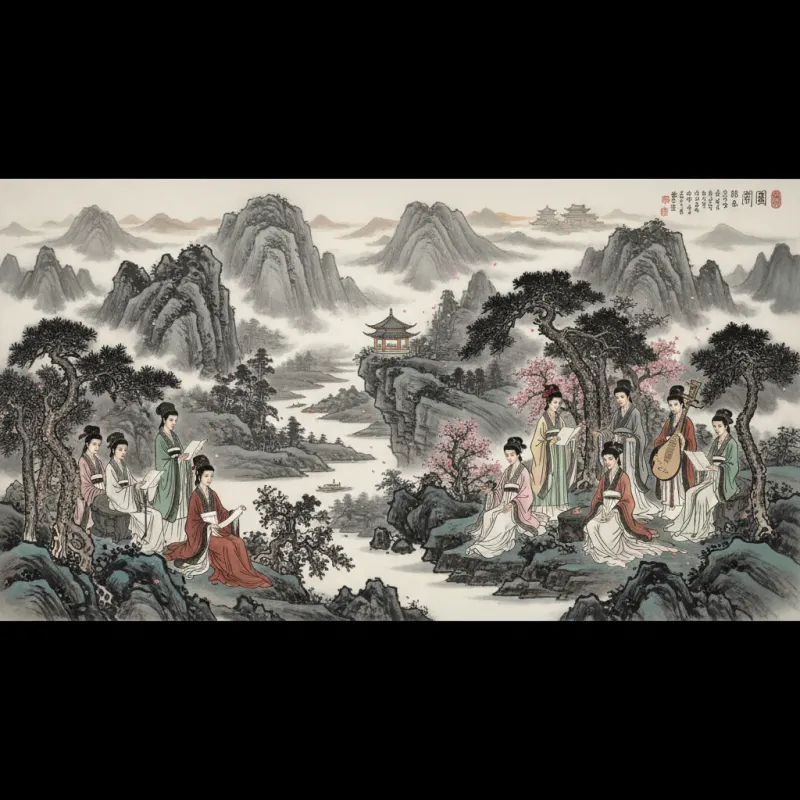
The palace fan lies abandoned in the autumn chest, its silk still perfect, its purpose forgotten. Ban Jieyu's poem "Resentment" (怨歌行, Yuàn Gē Xíng) uses this image to describe her own fate — a concubine discarded when the emperor's attention moved elsewhere. Written around 18 BCE, it's one of the earliest surviving poems by a Chinese woman, and it does something remarkable: it takes the language of imperial power and turns it into a weapon of critique. The fan isn't just a fan. It's every woman whose value was determined by male desire, every voice that was heard only when it pleased the listener.
This is the paradox at the heart of women's poetry in China. For three thousand years, the literary establishment told women they couldn't write serious poetry. Women wrote anyway. They wrote so well that even a system designed to erase them couldn't make their work disappear.
The Impossible Position of Early Women Poets
Ban Jieyu (班婕妤, c. 48-2 BCE) wasn't just a concubine — she was an educated court lady during the Han dynasty, versed in Confucian classics and historical texts. Her position gave her access to literary culture but also trapped her within it. When she wrote about the autumn fan, she was working within the fu (赋) tradition of elaborate descriptive poetry, a form dominated by male court poets. But she bent that tradition to express something the male poets rarely acknowledged: the precariousness of female existence in the palace system.
The poem's genius lies in its restraint. Ban Jieyu doesn't rage or weep. She observes. The fan is "cut from Qi's white silk" and "as round as the bright moon." Beautiful, valuable, perfectly crafted — and utterly disposable once autumn comes. The metaphor does all the work. This technique of indirect expression, of saying everything by seeming to say nothing, would become a hallmark of women's poetry in China.
What makes Ban Jieyu's survival in the literary record even more remarkable is that she lived centuries before the Tang dynasty, when poetry became central to Chinese cultural identity. Most Han dynasty poetry has been lost. That hers survived suggests it was copied, anthologized, and valued by later generations — despite her gender, or perhaps because her gender made her perspective unique enough to preserve.
The Tang Dynasty Exception
Li Ye (李冶, 730-784 CE) and Xue Tao (薛涛, 768-831 CE) represent something unusual in Chinese literary history: women poets who achieved recognition during their lifetimes. Both were courtesans, which paradoxically gave them more literary freedom than respectable women had. Courtesans were expected to write poetry, to engage in literary banter with male clients, to demonstrate cultural sophistication. The same Confucian ideology that kept respectable women confined to the inner quarters created a space where courtesan-poets could flourish.
Li Ye became a Daoist nun after an early scandal, and her poetry reflects both her religious practice and her continued engagement with the literary world. Her poem "Sent to a Hermit" plays with the conventions of Tang dynasty poetry — the mountain hermit, the seeker of wisdom — but from a female perspective that complicates the usual gender dynamics. When she writes about seeking a recluse in the mountains, she's claiming the role of spiritual seeker traditionally reserved for men.
Xue Tao went further. She invented her own paper — small sheets of deep red, perfect for the compressed intensity of quatrains. "Xue Tao paper" (薛涛笺, Xuē Tāo jiān) became famous throughout China, a material innovation that was also a statement: women's poetry deserved its own medium. Her work ranges from nature poems to political commentary, and she corresponded with major male poets of her era as an equal. When she wrote about frontier warfare or government corruption, she was entering territory that women supposedly couldn't understand.
But here's the catch: both Li Ye and Xue Tao could write freely partly because they existed outside respectable society. Their literary freedom came at the cost of social marginalization. Respectable women — the wives and daughters of officials — faced much stricter constraints.
Li Qingzhao and the Art of Domestic Genius
Li Qingzhao (李清照, 1084-1155) is often called China's greatest woman poet, and the qualifier "woman" is both necessary and infuriating. Necessary because her gender shaped her work in fundamental ways. Infuriating because it suggests she's great "for a woman" rather than simply great.
She wrote ci (词) poetry, song lyrics that were considered a lesser form than the classical shi (诗) poetry tested in the imperial examinations. But in Li Qingzhao's hands, ci became a vehicle for psychological complexity that the more formal shi couldn't match. Her early poems celebrate her marriage to Zhao Mingcheng, a scholar and antiquarian. They collected books and art together, studied inscriptions, played literary games. Her poems from this period are joyful, sensual, intellectually alive.
Then the Jin dynasty invaded northern China. Li Qingzhao and her husband fled south, losing most of their collection. Zhao Mingcheng died. Li Qingzhao spent her later years in poverty and obscurity, and her late poems are devastating. "Slow Slow Song" (声声慢, Shēng Shēng Màn) opens with seven repeated characters — "seeking, seeking, cold, cold, clear, clear, sad, sad, mournful, mournful" — that create a rhythm of desolation. The poem describes a widow's empty house, but it's also about the collapse of the Northern Song dynasty, the loss of an entire civilization.
What makes Li Qingzhao exceptional isn't just her technical skill, though that's formidable. It's her willingness to claim authority. She wrote a treatise on ci poetry that criticized male poets, including famous ones, for not understanding the form. She argued that ci required different techniques than shi, and that most men wrote bad ci because they treated it like shi. This was audacious. Women weren't supposed to write literary criticism. They certainly weren't supposed to tell famous male poets they were doing it wrong.
The Ming-Qing Explosion
Something shifted during the Ming (1368-1644) and Qing (1644-1912) dynasties. Women's literacy increased. Women's poetry clubs formed. Anthologies of women's poetry were published. The numbers are striking: scholars have identified over 3,000 women poets from the Qing dynasty alone, compared to perhaps a few dozen from all previous dynasties combined.
Part of this was economic. The commercialization of publishing made books cheaper and more available. Part was social. The cult of qing (情, emotion/feeling) in late Ming culture valued emotional authenticity, and women's poetry was seen as more emotionally genuine than men's. And part was the strange logic of Confucian ideology itself: if women were supposed to be educated enough to teach their sons, they needed access to classical texts. Once they had that access, some of them started writing.
The Banana Garden Poetry Club (蕉园诗社, Jiāo Yuán Shī Shè) in 17th-century Hangzhou brought together women from elite families to write, critique, and publish poetry. These weren't courtesans operating on the margins. These were respectable women, wives and daughters of officials, claiming literary space within the system that was supposed to exclude them.
But we should be careful about celebrating this too much. Most of these women still wrote under severe constraints. They wrote about domestic life, nature, emotions — "appropriate" subjects for women. When they wrote about politics or philosophy, they often had to frame it as personal or emotional rather than intellectual. And the vast majority of women, the peasants and workers who made up most of China's population, remained illiterate and voiceless.
What Survived and What Didn't
Here's a sobering fact: we don't know how much women's poetry has been lost. We know that families sometimes destroyed a woman's writings after her death, considering them inappropriate or embarrassing. We know that anthologies compiled by men often excluded women's work or included only a token few poems. We know that the imperial examination system, which shaped what counted as "serious" poetry for over a thousand years, was closed to women.
The poetry that survived often did so through accident or exceptional circumstances. Ban Jieyu's poem survived because it was so famous it got anthologized early. Li Qingzhao's work survived partly because her husband's family preserved it, and partly because she was so obviously talented that even male critics couldn't ignore her. The Qing dynasty women poets survived because they published collectively, creating a critical mass that was harder to erase.
But think about all the women who didn't have those advantages. The peasant woman who composed songs while working in the fields. The merchant's daughter who wrote poems but never showed them to anyone. The concubine whose work was destroyed when she fell out of favor. Chinese literary history is full of ghosts — voices we know existed but can't hear.
Reading Women's Poetry Now
When you read women's poetry from imperial China, you're reading through layers of constraint and strategy. The poet who writes about embroidery might be writing about embroidery, or she might be writing about the tedious constraints of women's work, or she might be using embroidery as a metaphor for poetic craft itself. The poem that seems to be about missing a husband might be about political exile. The nature poem might be about nature, or it might be the only way the poet could write about freedom.
This isn't unique to Chinese women's poetry — women writers everywhere have had to develop strategies for saying what they weren't supposed to say. But Chinese poetry's emphasis on allusion, indirection, and layered meaning made it particularly suited to this kind of coded communication. The same techniques that male poets used to reference classical texts and historical events, women poets used to smuggle forbidden content past the censors of propriety.
The result is poetry that rewards close reading and historical knowledge. When Xue Tao writes about frontier warfare, you need to know that women weren't supposed to write about military matters. When Li Qingzhao criticizes male poets, you need to understand how radical that was. When a Qing dynasty woman writes about female friendship with the intensity usually reserved for romantic love, you need to recognize that she's creating an alternative emotional world where women's relationships matter as much as relationships with men.
These poems aren't just historical artifacts. They're evidence of intellectual and creative lives lived against enormous odds. They're proof that the human need to make art, to shape experience into language, to leave some trace of consciousness behind — that need is stronger than any system designed to suppress it. The palace fan may end up in the autumn chest, but the poem about the palace fan survives for two thousand years. That's not nothing. That's everything.
Related Reading
- Wang Wei: The Poet-Painter Who Captured Silence
- Du Fu: The Conscience of Chinese Poetry
- Bai Juyi: The Song of Everlasting Sorrow
- Tao Yuanming: The Recluse Who Found Paradise
- Li Bai vs Du Fu: The Rivalry That Defined Chinese Poetry
- The Moon in Chinese Poetry: 50 Ways to Say 'I Miss You'
- The Enchantment of Song Dynasty Poets: A Deep Dive into Their Timeless Verses
- The Complete Guide to Chinese Classical Poetry: From Tang Poems to Song Ci
Explore Chinese Culture
- Explore the Tang dynasty's golden age
- Explore Daoist themes in classical poetry
- Explore Chinese literary traditions