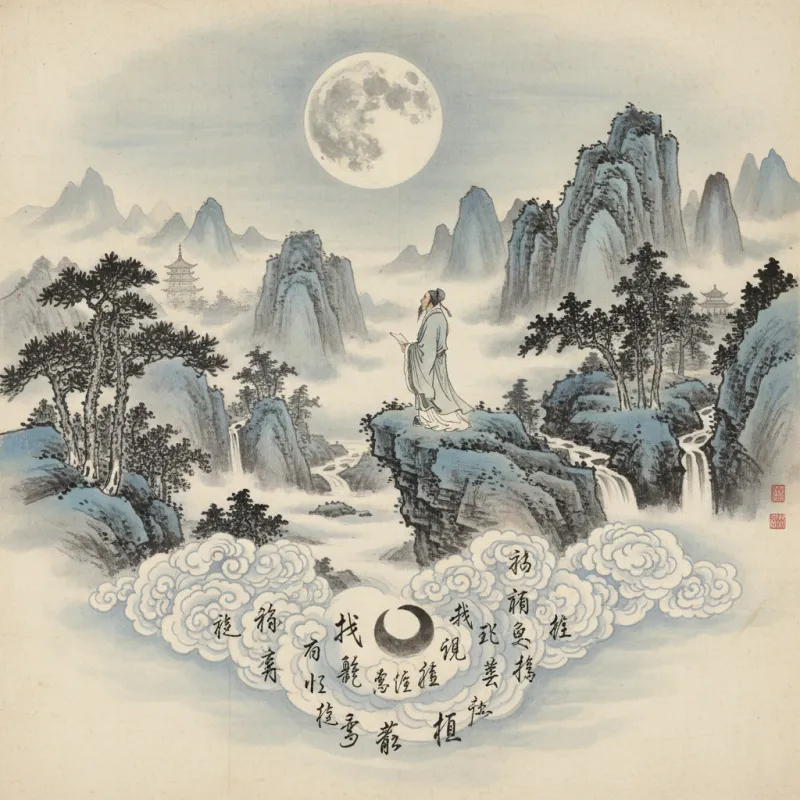
When Li Bai drowned trying to embrace the moon's reflection in the Yangtze River — or so the legend goes — he was just doing what Chinese poets had been doing for centuries: reaching for something beautiful and impossibly far away. The moon wasn't just a celestial body in classical Chinese poetry. It was a messenger, a mirror, a silent companion, and most of all, a way to say "I miss you" without actually saying it.
The numbers tell part of the story. In the Complete Tang Poems (全唐诗 Quán Tángshī), a collection of roughly 49,000 poems, the character 月 (yuè, moon) appears in over 10,000 of them. That's one in five poems. The moon shows up more than mountains, more than rivers, more than plum blossoms — even more than wine, though wine runs a close second. But numbers don't explain why Tang and Song dynasty poets were so obsessed with this particular image, or why reading their moon poems today still feels like eavesdropping on someone's most private thoughts.
The Shared Screen of the Ancient World
Here's what you need to understand about imperial China: it was vast, and people were constantly being separated. Officials got posted to frontier garrisons thousands of miles from home. Scholars traveled to the capital for examinations and didn't return for years. Families were split across provinces. There were no phones, no video calls, no way to see someone's face once they left. Letters took months.
But everyone could see the moon. If you were stationed at the western frontier in Dunhuang (敦煌 Dūnhuáng) and your wife was in Chang'an (长安 Cháng'ān), you could look up on the fifteenth day of the eighth month and know she was seeing the exact same moon at the exact same time. It was the ancient world's only shared screen. This is why the Mid-Autumn Festival (中秋节 Zhōngqiū Jié) became the festival of reunion — not because families actually reunited, but because the full moon let separated people feel connected across impossible distances.
Du Fu (杜甫 Dù Fǔ) captured this perfectly in a poem written during the An Lushan Rebellion, when he was separated from his family: "Tonight the moon in Fuzhou, / In her chamber she watches alone" (今夜鄜州月,闺中只独看 jīn yè Fūzhōu yuè, guī zhōng zhǐ dú kàn). He's in one place, his wife is in another, but the moon connects them. The poem doesn't say "I miss you." It doesn't need to.
Li Bai's Moon Obsession
No poet took the moon more seriously than Li Bai (李白 Lǐ Bái, 701-762). He wrote about it constantly — in drinking songs, in exile poems, in poems about friendship and loneliness and the passage of time. His most famous moon poem, "Drinking Alone Under the Moon" (月下独酌 Yuè Xià Dú Zhuó), starts with him drinking by himself in a garden. He invites the moon and his shadow to join him, making three. Then he gets drunk and dances with his shadow while the moon watches. It's playful and sad at the same time, which is very Li Bai.
But his best moon line might be from "Quiet Night Thought" (静夜思 Jìng Yè Sī), a poem so famous that every Chinese schoolchild memorizes it: "I raise my head to gaze at the bright moon, / I lower my head and think of home" (举头望明月,低头思故乡 jǔ tóu wàng míng yuè, dī tóu sī gù xiāng). Four lines, twenty characters total, and it captures exactly what the moon meant in Chinese poetry. You look at it, and immediately you think of the people you can't see.
The legend that Li Bai drowned trying to embrace the moon's reflection is almost certainly false — he probably died of illness — but it's the kind of story that should be true. It fits perfectly with how he wrote about the moon: as something beautiful and untouchable that you reach for anyway.
Fifty Ways to Say the Same Thing
Chinese poets developed an entire vocabulary for moon-gazing and homesickness. They rarely said "I miss you" directly — that would be too plain, too emotional, too exposed. Instead they described the moon and let you fill in the rest. Here are some of the patterns:
The moon is bright, which means you're thinking clearly about your loneliness. The moon is cold (寒月 hán yuè), which means your separation feels physical. The moon is broken or incomplete (残月 cán yuè), which means you feel broken too. The moon hangs over the frontier pass (关山月 Guānshān yuè), which means you're far from home in a dangerous place. The moon shines on the river (江月 jiāng yuè), which means you're traveling and lonely. The moon enters your window (月入窗 yuè rù chuāng), which means you're lying awake at night thinking about someone.
Zhang Jiuling (张九龄 Zhāng Jiǔlíng, 678-740) wrote what might be the most direct moon-as-messenger poem: "The moon, grown full now over the sea, / Brightening the whole of heaven, / Brings to separated hearts / The long thoughtfulness of night" (海上生明月,天涯共此时 hǎi shàng shēng míng yuè, tiān yá gòng cǐ shí). The moon rises over the ocean, and suddenly everyone at "the ends of the earth" is connected. It's a love poem, but it works for any kind of separation — friends, family, lovers, anyone you can't reach.
The Moon and Wine
The moon appears in Chinese poetry most often alongside wine (酒 jiǔ), and this pairing tells you something important about how poets used both. Wine loosens you up enough to admit you're lonely. The moon gives you something to look at while you're admitting it. Together they create the perfect conditions for writing poetry about feelings you'd normally keep hidden.
Li Bai again: "A pot of wine among the flowers, / I drink alone, no friend with me. / I raise my cup to invite the bright moon, / With my shadow we become three" (花间一壶酒,独酌无相亲。举杯邀明月,对影成三人 huā jiān yī hú jiǔ, dú zhuó wú xiāng qīn. Jǔ bēi yāo míng yuè, duì yǐng chéng sān rén). The wine is why he's drinking alone. The moon is why he's not completely alone. The poem is why we're still reading about it 1,300 years later.
This combination shows up everywhere in Tang poetry. Su Shi (苏轼 Sū Shì, 1037-1101), writing during the Song dynasty, took it even further in "Prelude to Water Melody" (水调歌头 Shuǐ Diào Gē Tóu). He gets drunk during the Mid-Autumn Festival and asks the moon: "What grudge can the moon have, that when people part it becomes full?" (月有阴晴圆缺,此事古难全 yuè yǒu yīn qíng yuán quē, cǐ shì gǔ nán quán). He's annoyed that the moon is full and bright when he's separated from his brother. Then he realizes: "Men have sorrow and joy; they part and meet again. / The moon dims or shines; it waxes and wanes. / There has never been anything perfect since the beginning of time" (人有悲欢离合,月有阴晴圆缺,此事古难全 rén yǒu bēi huān lí hé, yuè yǒu yīn qíng yuán quē, cǐ shì gǔ nán quán). The moon's changes mirror human separation. That's the point.
Why the Moon Still Works
You might think moon poems would feel dated now. We know the moon is just a rock. We've been there. We have actual ways to stay connected across distances. But Tang and Song moon poems still hit because they're not really about the moon. They're about the gap between where you are and where you want to be, between who you're with and who you're missing.
The moon in Chinese poetry is a trick. Poets describe it in elaborate detail — its brightness, its position in the sky, how it reflects on water or shines through windows — and while you're paying attention to these images, they're actually writing about loneliness and distance and time passing. The moon is just the vehicle. The real subject is always the same: I'm here, you're there, and I wish things were different.
Wang Wei (王维 Wáng Wéi, 699-759) understood this. His poem "Thinking of My Brothers on a Moonlit Night" (月夜忆舍弟 Yuè Yè Yì Shè Dì) describes the moon shining on different places where his brothers might be, then ends: "The dew tonight will be frost, / How much brighter the moon over my old home!" (露从今夜白,月是故乡明 lù cóng jīn yè bái, yuè shì gù xiāng míng). The moon over his childhood home is brighter — not because it actually is, but because that's where his heart is. The moon becomes a measure of emotional distance, not physical distance.
Reading Moon Poems Now
When you read Tang and Song poetry about the moon, you're reading a code that everyone at the time understood. Moon equals separation. Bright moon equals acute awareness of separation. Full moon equals the separation is especially painful because this is when families should be together. Cold moon equals the separation has lasted a long time. Moon over water equals you're traveling. Moon through a window equals you're lying awake thinking about it.
Once you know the code, you can read between the lines. A poem that seems to be describing scenery — the moon rising over mountains, reflecting in a river, shining on frost — is actually someone writing about missing home, or missing a friend, or missing a lover, or just feeling alone in the world. The landscape is the feeling made visible.
This is why Chinese poetry about nature and seasons works differently than Western nature poetry. It's rarely just about nature. The plum blossoms, the autumn leaves, the spring rain — they're all code for human emotions. And the moon is the most versatile code of all, because everyone sees it, everyone understands what it means, and no one has to say "I miss you" out loud.
The moon in Chinese poetry is fifty ways to say the same thing. But sometimes you need fifty ways, because saying it once, directly, wouldn't be enough. You need the bright moon and the cold moon and the autumn moon and the moon over the frontier and the moon in the wine cup and the moon reflected in water. You need all of them to capture what it feels like to be far from home, far from the people you love, looking up at the one thing that connects you.
Related Reading
- Nature Poetry in Chinese Literature: Seeing the World as the Poets Saw It
- The Art of Nature in Tang, Song, and Yuan Dynasty Poetry: A Literary Exploration
- The Four Seasons in Chinese Poetry: A Seasonal Reading Guide
- Mountain and Water Poetry (山水诗): When Landscape Becomes Literature
- Nature Poetry in the Tang Dynasty: Mountains, Rivers, and the Art of Seeing
- Zen Poetry: Enlightenment in Seventeen Syllables
- What Is Tang Poetry? A Complete Introduction for English Readers
- Women Poets of China: Voices Across Three Millennia
Explore Chinese Culture
- Explore the Tang dynasty's golden age
- Explore Daoist themes in classical poetry
- Explore Chinese literary traditions