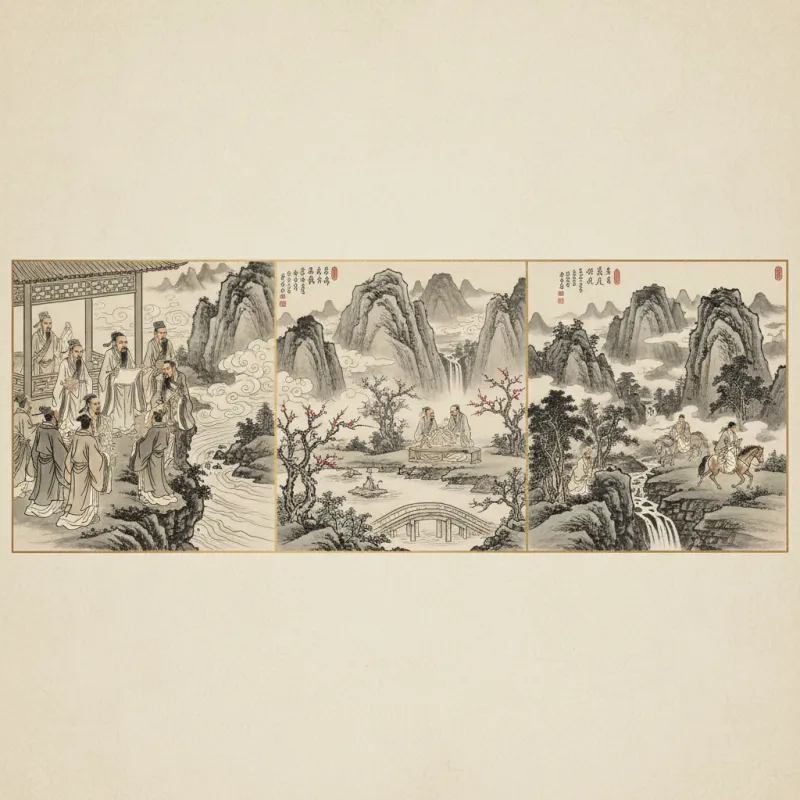
Picture a moonlit night in 742 CE. Li Bai (李白, Lǐ Bái), already drunk on wine and wandering, stands before a waterfall and declares it "a torrent of the Milky Way set free from Heaven's nine-fold height." This isn't mere description—it's cosmic audacity, the kind of imaginative leap that defined an entire era of Chinese poetry. The Tang, Song, and Yuan dynasties didn't just produce beautiful verses; they created distinct philosophical universes, each with its own way of seeing the world, feeling emotion, and wrestling with what it means to be human.
The Tang Dynasty: When Poetry Became the Measure of a Man
The Tang dynasty (618-907 CE) made poetry a requirement for civil service examinations. Imagine that—your career as a government official depended on your ability to craft perfect lüshi (律詩, regulated verse) under pressure. This wasn't some quaint cultural quirk; it fundamentally shaped how educated Chinese people thought, communicated, and understood reality itself.
Li Bai embodied the Daoist strain of Tang poetry—spontaneous, wine-soaked, obsessed with nature and transcendence. His contemporary Du Fu (杜甫, Dù Fǔ) took the opposite path, becoming what later critics called the "poet-historian," documenting the An Lushan Rebellion's devastation with unflinching precision. When Du Fu writes "The nation is shattered, but mountains and rivers remain," he's not being poetic—he's recording the literal collapse of order while asserting that something deeper persists.
The Tang poets mastered jueju (絕句, quatrains) and lüshi, forms so technically demanding that every syllable's tone had to follow prescribed patterns. Yet within these rigid structures, they achieved startling freedom. Wang Wei (王維, Wáng Wéi) could evoke an entire Buddhist philosophy in twenty characters, while Bai Juyi (白居易, Bái Jūyì) wrote with such clarity that, legend says, he'd test his poems on an old woman to ensure anyone could understand them.
The Song Shift: Inward Turns and Lyric Intimacy
When the Song dynasty (960-1279 CE) emerged after decades of fragmentation, something fundamental changed in Chinese poetry. The grand gestures gave way to what we might call psychological realism. The dominant form became ci (詞, lyric poetry), originally song lyrics set to popular tunes, often with irregular line lengths that broke free from Tang formalism.
Su Shi (蘇軾, Sū Shì), also known as Su Dongpo, revolutionized ci by treating it as seriously as classical shi poetry. His "Prelude to Water Melody" written during the Mid-Autumn Festival of 1076—while he was in political exile—asks his absent brother: "People have sorrow and joy, separation and reunion; the moon waxes and wanes. Such has always been the case." This isn't resignation; it's a hard-won philosophical acceptance that feels utterly modern in its emotional honesty.
Li Qingzhao (李清照, Lǐ Qīngzhào), the Song's greatest female poet, brought unprecedented intimacy to ci. Her early works capture domestic happiness with sensual precision—yellow flowers, light mist, the weight of jade ornaments. After her husband's death and the Jin invasion forced her south, her poetry darkened into something almost unbearable: "Searching, seeking, cold and desolate, wretched and miserable and forlorn." The repetition of those searching words (xun xun mi mi 尋尋覓覓) creates a rhythm of desperate, futile motion that you can feel in your chest.
The Song poets were also Neo-Confucian philosophers, and their poetry reflects this. They weren't just describing nature—they were investigating li (理, principle) through careful observation. When Song dynasty thinkers explored the relationship between poetry and philosophy, they created a tradition where aesthetic experience became a path to moral and metaphysical truth.
Yuan Dynasty: Conquest, Resistance, and the Sanqu Form
The Mongol conquest that established the Yuan dynasty (1271-1368 CE) created a strange paradox for Chinese literati. The civil service examinations were suspended for decades, cutting off the traditional path to power and prestige. Many educated Chinese found themselves politically marginalized, even as Mongol rulers patronized Chinese culture to legitimize their rule.
This produced the sanqu (散曲, free verse) form—looser, more colloquial than Song ci, often incorporating vernacular language and folk elements. Guan Hanqing (關漢卿, Guān Hànqīng), who also wrote zaju (雜劇, variety plays), used sanqu to voice social criticism that would have been dangerous in more formal genres. His poems about courtesans, corrupt officials, and ordinary people's suffering have a raw edge that earlier poetry often lacked.
Ma Zhiyuan (馬致遠, Mǎ Zhìyuǎn) wrote what might be the most famous sanqu ever: "Autumn Thoughts." In just twenty-eight characters, he creates a landscape of exile and loneliness—withered vines, old trees, crows at dusk, a small bridge, flowing water, an ancient road, west wind, a thin horse, and finally "the heartbroken man at sky's edge." Every image is a cliché of Chinese poetry, yet assembled together they achieve something devastating.
The Yuan period also saw increased interest in the relationship between poetry and dramatic performance, as sanqu lyrics became integral to the flourishing zaju theater tradition. Poetry was no longer just for reading—it was for singing, performing, embodying.
Technical Mastery: The Bones Beneath the Beauty
Understanding Chinese classical poetry requires grappling with its technical foundations. The tonal system of Middle Chinese created natural music in the language itself—each character had one of four tones (level, rising, departing, entering), and regulated verse required specific tonal patterns. When a Tang poet wrote a lüshi, they were essentially composing music without notation.
Parallelism (duizhang 對仗) was another crucial technique, especially in the middle couplets of lüshi. Lines had to mirror each other grammatically and semantically—noun for noun, verb for verb, often with contrasting imagery. Du Fu's "Spring View" demonstrates this perfectly: "The nation shattered, mountains-rivers remain; city spring, grass-trees deep." The parallel structure creates a tension between destruction and persistence, human failure and natural continuity.
The use of diangu (典故, classical allusions) added layers of meaning. A single reference to an ancient text, historical figure, or earlier poem could evoke entire philosophical traditions or emotional contexts. This made Chinese poetry deeply intertextual—every poem existed in conversation with centuries of previous poems.
Philosophy in Five-Character Lines
Chinese classical poetry wasn't decoration for philosophical ideas—it was philosophy itself, a way of thinking through language's unique capacities. The Buddhist concept of kong (空, emptiness) finds perfect expression in Wang Wei's landscape poems, where human presence dissolves into natural processes. The Daoist ideal of ziran (自然, spontaneous naturalness) animates Li Bai's seemingly effortless verses.
Confucian ethics permeate the tradition too, though often in tension with Daoist and Buddhist impulses. Du Fu's social conscience, his insistence on witnessing and recording suffering, reflects the Confucian mandate that the junzi (君子, exemplary person) must engage with the world's problems. Yet even Du Fu's most politically engaged poems achieve a transcendent quality that exceeds any single philosophical framework.
The Song Neo-Confucians, particularly the Cheng brothers and Zhu Xi, argued that poetry could cultivate moral character by training attention and refining emotion. Reading and writing poetry became spiritual practice, a way of aligning oneself with the cosmic pattern. This helps explain why Chinese aesthetics emphasized the unity of moral and artistic cultivation.
Why These Poems Still Matter
In our age of information overload and fractured attention, Chinese classical poetry offers something radical: the possibility that constraint enables rather than limits expression, that tradition can be a source of innovation rather than mere repetition, that the smallest observations can contain the largest truths.
These poems also remind us that different cultures have developed fundamentally different ways of using language to capture experience. Chinese poetry's imagistic compression, its reliance on juxtaposition rather than explicit connection, its integration of visual and verbal elements—these aren't just stylistic choices but different ways of thinking about how meaning emerges.
The Tang, Song, and Yuan poets created a tradition that influenced not just Chinese literature but Korean, Japanese, and Vietnamese poetry as well. When Matsuo Bashō wrote haiku in 17th-century Japan, he was working within aesthetic principles developed by Tang and Song poets. When Ezra Pound and the Imagists revolutionized English poetry in the early 20th century, they were drawing on Chinese models (however imperfectly understood).
Reading Across the Centuries
The challenge and reward of engaging with Chinese classical poetry today is that it requires us to develop new reading skills. We must learn to appreciate tonal music we can't hear, to recognize allusions we don't know, to feel the weight of characters whose visual form carries meaning beyond sound.
Yet even in translation, these poems retain extraordinary power. Li Bai's loneliness under the moon, Li Qingzhao's grief, Ma Zhiyuan's autumn desolation—these emotions transcend their specific cultural contexts while remaining deeply rooted in them. The best translations don't try to make Chinese poetry sound like English poetry; they help us hear something genuinely foreign, genuinely other, and discover that otherness speaks to something universal.
The timeless elegance of Chinese classical poetry lies not in some abstract beauty but in its makers' ability to compress vast experience into minimal language, to find the exact image that makes the invisible visible, to create forms so perfect they seem inevitable yet so surprising they feel like revelation. From Tang exuberance through Song introspection to Yuan experimentation, these poets built a tradition that continues to challenge and inspire anyone willing to enter its demanding, rewarding world.
Related Reading
- Daoist Poetry: The Art of Doing Nothing
- Daoist Poetry: Finding the Way Through Nature
- Poetry as Philosophy: How Chinese Poets Think
- Confucian Values in Classical Chinese Poetry: Duty, Loyalty, and the Weight of the World
- Zen Poetry: Enlightenment in Seventeen Syllables
- Mountain and Water Poetry (山水诗): When Landscape Becomes Literature
- Su Shi in Exile: Making the Best of Banishment
- Patriotic Poetry in Chinese History: From Qu Yuan to Modern Times
Explore Chinese Culture
- Explore the Tang dynasty's golden age
- Explore Daoist themes in classical poetry
- Explore Chinese literary traditions