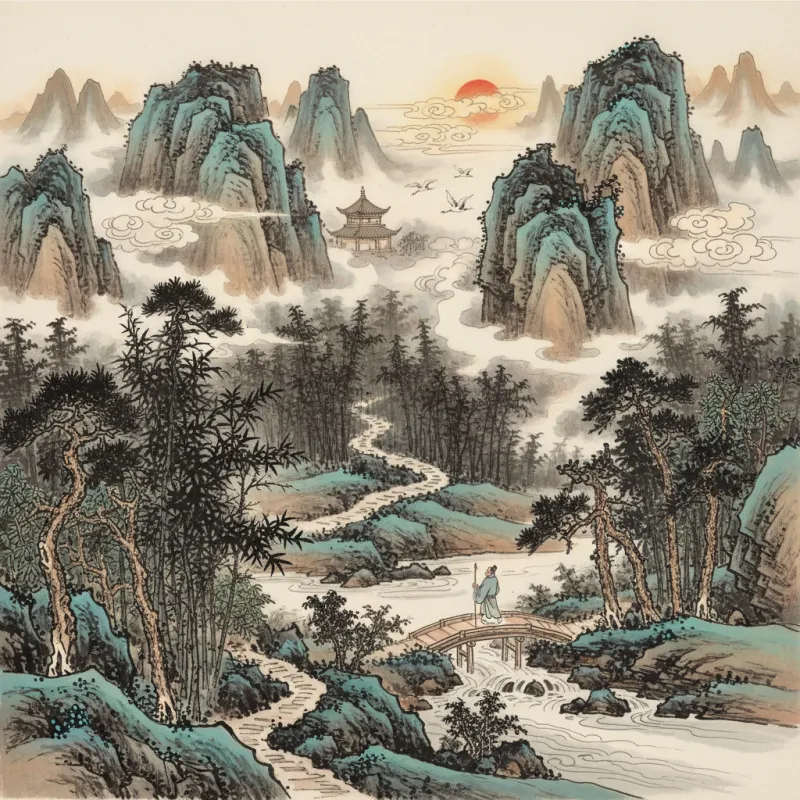
A pine tree grows from a crack in the cliff face, twisted by wind, roots gripping bare rock. No gardener planted it there. No one waters it or prunes its branches. Yet it thrives in a place where nothing should survive, its needles dark green against the stone. This is the image that haunts Daoist poetry — not the cultivated garden with its careful arrangements, but the wild thing that simply is, without trying to be anything at all.
Daoist poetry is the art of getting out of the way. Where Confucian poetry argues for social responsibility and Buddhist poetry seeks enlightenment through discipline, Daoist poetry says: stop striving, stop analyzing, stop trying to improve things. Just look at the mountain. The mountain is enough.
This might sound like laziness dressed in philosophy. But the Daoist poetic tradition — running from the pre-Tang period through the golden age of Tang poetry and into the Song dynasty — produced some of the most precise, vivid, and emotionally powerful nature writing in any language. It turns out that paying attention without agenda is harder than it sounds and more revelatory than you'd expect.
The Philosophical Foundation: Wu Wei and the Natural World
The core concept driving Daoist poetry is wu wei (無為 wúwéi), often translated as "non-action" or "effortless action." This isn't passivity. It's the idea that the most effective action flows from alignment with the natural order of things — the Dao (道 dào), the "Way" that underlies all existence. Water doesn't force its way downhill; it simply follows the path of least resistance and eventually carves through stone.
For Daoist poets, nature becomes both subject and teacher. Mountains, rivers, clouds, and trees aren't just pretty scenery — they're demonstrations of how to exist without pretense. The bamboo bends in the storm and survives; the rigid oak breaks. The stream flows around obstacles; it doesn't waste energy trying to move them. These aren't metaphors imposed on nature. They're observations of how things actually work when human interference is removed.
This philosophical stance puts Daoist poetry in direct tension with Confucian values that dominated Chinese literary culture. Confucianism emphasized social duty, hierarchical relationships, and active participation in government. The ideal Confucian poet wrote about moral cultivation and political responsibility. The Daoist poet, by contrast, often wrote from a position of withdrawal — the retired official, the hermit, the wanderer who'd given up on reforming society and decided to watch clouds instead.
The Daoist Poetic Voice: Tao Yuanming's Revolutionary Simplicity
Tao Yuanming (陶淵明 Táo Yuānmíng, 365-427 CE) essentially invented the Daoist poetic voice that would echo through Chinese literature for the next thousand years. After a brief, miserable career as a county magistrate, he quit government service at age 41 and returned to farming. His poetry celebrates this choice with a directness that was radical for its time.
Consider his most famous lines from "Returning to Dwell in Gardens and Fields" (歸園田居 Guī yuán tián jū):
I built my hut beside a traveled road
Yet hear no noise of passing carts and horses
You ask how this can be?
When the heart is distant, place becomes remote
There's no elaborate imagery here, no classical allusions to demonstrate erudition. Just a simple observation: physical withdrawal isn't necessary if you've achieved mental detachment. The poem continues with Tao Yuanming picking chrysanthemums by his fence and glimpsing the distant mountain — not as a planned aesthetic experience, but as something that happens naturally when you're not trying to make things happen.
This simplicity was deceptive. Tao Yuanming's poems look effortless, but they're carefully constructed to feel unconstructed. He uses plain language and everyday scenes to convey philosophical depth without announcing it. His influence on later poets, especially Wang Wei and the Tang dynasty nature poets, cannot be overstated. He showed that you could write about drinking wine and weeding your garden and still be writing about the fundamental nature of existence.
Wang Wei and the Landscape of Emptiness
Wang Wei (王維 Wáng Wéi, 699-759 CE) took Daoist poetics in a more explicitly Buddhist direction, but his core technique remained Daoist: present the natural scene with such clarity that philosophical meaning emerges without commentary. His famous quatrain "Deer Park" (鹿柴 Lù zhài) demonstrates this perfectly:
Empty mountain, no one in sight
Only the sound of someone talking
Returning sunlight enters the deep forest
Shining again on the green moss
The poem is almost aggressively simple. Four lines, four images. But notice what Wang Wei does: he presents emptiness first, then contradicts it with sound, then shows light penetrating darkness. The poem enacts the Daoist principle that emptiness isn't absence — it's the space where things can happen. The empty mountain contains sound. The dark forest contains light. Nothing is forced; everything is observed.
Wang Wei's poetry often depicts moments of transition — dusk, dawn, the boundary between seasons. These liminal times reflect the Daoist understanding that reality is fluid, constantly changing, never fixed. His landscapes are rarely dramatic. He prefers the quiet corner, the overlooked detail, the moment when nothing much seems to be happening but everything is actually in motion.
His integration of Buddhist concepts like emptiness (kong 空) with Daoist naturalism created a hybrid poetic that influenced centuries of Chinese landscape poetry. But unlike explicitly Buddhist poetry that uses nature as a vehicle for religious teaching, Wang Wei's poems resist interpretation. They present the scene and trust the reader to experience it directly, without mediation.
Li Bai's Ecstatic Daoism
If Wang Wei represents the contemplative strain of Daoist poetry, Li Bai (李白 Lǐ Bái, 701-762 CE) embodies its ecstatic, wine-soaked, moon-drunk alternative. Li Bai was a Daoist in the tradition of the immortality-seeking, alchemy-practicing, convention-defying mystics who populated Daoist legends. His poetry celebrates spontaneity, intoxication, and the kind of freedom that comes from not caring what anyone thinks.
His poem "Drinking Alone Beneath the Moon" (月下獨酌 Yuè xià dú zhuó) captures this perfectly:
Among the flowers, a jug of wine
I pour alone, no friend with me
I raise my cup to invite the moon
My shadow makes us three
Li Bai's Daoism isn't about quiet contemplation. It's about dissolving the boundary between self and world through sheer exuberance. He drinks with the moon, converses with mountains, and claims to have met immortals in his wanderings. Whether he actually believed these things or was performing a poetic persona is beside the point — the poems enact a state of consciousness where such distinctions don't matter.
His relationship with nature is more active than Wang Wei's. Li Bai doesn't just observe mountains; he climbs them, often drunk, and shouts poetry at them. He doesn't quietly note the moon's reflection; he tries to embrace it and falls in the water (according to legend, this is how he died). His poetry demonstrates that wu wei doesn't mean stillness — it can also mean moving with such complete spontaneity that action and non-action become the same thing.
The Song Dynasty Refinement
By the Song dynasty (960-1279 CE), Daoist poetic techniques had become so integrated into Chinese literary culture that poets could employ them without necessarily identifying as Daoists. Su Shi (蘇軾 Sū Shì, 1037-1101 CE), for instance, was a Confucian official who wrote some of the most Daoist poetry in the Chinese canon.
His famous "Red Cliff Ode" (赤壁賦 Chìbì fù) describes a boat trip where he and his friends drink wine and contemplate the river. The piece moves from historical reflection (the site was a famous battle) to philosophical meditation on the transience of human affairs versus the permanence of nature. But then Su Shi makes a Daoist turn: maybe nothing is permanent, and maybe nothing is transient. The river is always changing and always the same. The moon waxes and wanes but never truly grows or shrinks.
This kind of paradox-embracing, category-dissolving thinking is pure Daoism, even when it appears in the work of a Confucian bureaucrat. The Song dynasty poets refined Daoist poetics into a sophisticated literary technique that could be deployed alongside other philosophical and aesthetic approaches. The result was poetry of extraordinary subtlety, where Daoist, Buddhist, and Confucian elements coexist without contradiction.
The Technique of Spontaneity
Here's the paradox at the heart of Daoist poetry: it aims for spontaneity but achieves it through craft. The poems that feel most effortless are often the most carefully constructed. This isn't hypocrisy — it's the recognition that true spontaneity requires practice. The musician who improvises brilliantly has spent years mastering their instrument. The Daoist poet who captures a moment of natural clarity has spent years learning to see clearly.
The technical features of Daoist poetry reflect this. The language tends toward simplicity, avoiding elaborate metaphors and classical allusions that would draw attention to the poet's erudition. The imagery focuses on direct sensory experience — what you can see, hear, smell, touch. The structure often follows natural rhythms rather than imposed formal patterns, though within the constraints of classical Chinese prosody.
Most importantly, Daoist poetry avoids explicit interpretation. The poet presents the scene and trusts it to speak for itself. This is harder than it sounds. The impulse to explain, to make sure the reader gets the point, is strong. Daoist poetry resists this impulse. It offers the image and steps back, allowing the reader to experience it directly rather than through the filter of the poet's commentary.
Why Daoist Poetry Still Matters
In an age of constant commentary, hot takes, and the compulsion to have an opinion about everything, Daoist poetry offers an alternative: the discipline of attention without agenda. It suggests that sometimes the most profound response to the world is to describe it accurately and let it be what it is.
This doesn't mean Daoist poetry is apolitical or escapist, though it's often accused of both. Choosing to write about mountains instead of court politics is itself a political statement. Celebrating withdrawal and simplicity in a culture that values ambition and complexity is a form of resistance. The Daoist poet who quits government service to grow vegetables is making a radical claim about what constitutes a meaningful life.
The techniques of Daoist poetry — clarity, simplicity, direct observation, trust in the image — remain relevant for contemporary writers working in any tradition. The philosophical stance — that reality is interesting enough without our constant interpretation and improvement — offers a corrective to the exhausting self-consciousness of modern culture.
The pine tree is still growing from the cliff face, twisted by wind, gripping bare rock. It doesn't need our theories about resilience or our metaphors about perseverance. It's just there, being a tree, doing what trees do. Daoist poetry suggests that paying attention to this — really paying attention, without trying to make it mean something — might be enough. Might even be everything.
For more on how different philosophical traditions shaped Chinese poetry, see Confucian Poetry and Social Harmony and Buddhist Poetry and Enlightenment.
Related Reading
- The Timeless Elegance of Chinese Classical Poetry: Tang, Song, and Yuan Eras
- Daoist Poetry: The Art of Doing Nothing
- Zen Poetry: Enlightenment in Seventeen Syllables
- Poetry as Philosophy: How Chinese Poets Think
- Confucian Values in Classical Chinese Poetry: Duty, Loyalty, and the Weight of the World
- Exploring Chinese Classical Poetry: Tang, Song, and Yuan Poets’ Literary Legacy
- Jueju: The Art of the Four-Line Poem
- The Great Poets of China: Li Bai, Du Fu, and the Rivalry That Never Was
Explore Chinese Culture
- Explore the Tang dynasty's golden age
- Explore Daoist themes in classical poetry
- Explore Chinese literary traditions