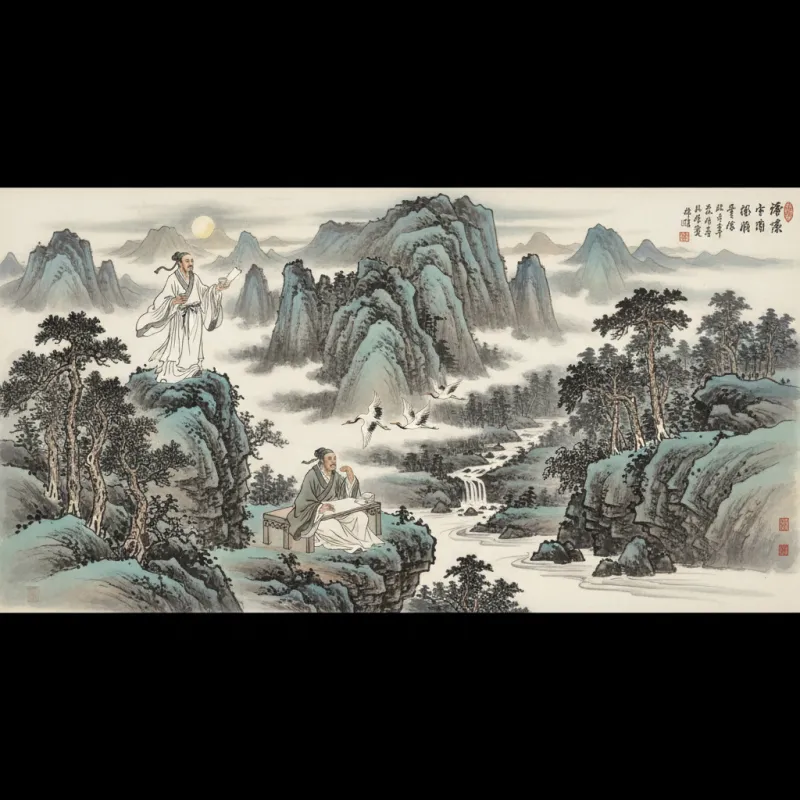
Picture this: two men in their forties, sitting by a river in Shandong province, drinking wine and trading verses. One is already famous across China, the other still climbing toward recognition. They'll meet only twice in their lives, spend perhaps a few months together total, then never see each other again. One will write twelve poems about the other. The other will write four in return. Centuries later, scholars will call this a "rivalry" — one of the great literary feuds of Chinese history. Except it never happened.
The supposed rivalry between Li Bai (李白, Lǐ Bái) and Du Fu (杜甫, Dù Fǔ) is one of those convenient fictions that makes for tidy literary history. It's the kind of story that works perfectly in a textbook: two titans, two opposing styles, locked in eternal competition. The Romantic versus the Realist. The wild genius versus the careful craftsman. Apollo and Dionysus in Tang dynasty robes.
The truth is messier and more human. These two men met, liked each other, wrote poems expressing genuine affection, and then life pulled them in different directions. That's it. No feud, no competition, no dramatic falling out. Just two poets who crossed paths briefly during China's golden age of verse.
The Meetings That Actually Happened
We know they met twice, maybe three times, between 744 and 745 CE. The first meeting was in Luoyang, the eastern capital, where Li Bai was already a celebrity at forty-three and Du Fu was a struggling thirty-three-year-old still trying to pass the civil service examinations. They hit it off immediately.
They traveled together through Shandong and Henan provinces, visiting Taoist temples, drinking in wine shops, and writing poems. Du Fu's "Presented to Li Bai" from this period reads like a fan letter: "Your poetry shakes the five peaks / Your verses rival the elegance of Xie Lingyun." This isn't competitive trash talk. This is admiration bordering on worship.
The second confirmed meeting was later that same year, when they rendezvoused with another poet, Gao Shi (高适, Gāo Shì), and the three of them went hunting with falcons. Du Fu wrote about this too, preserving the memory of what must have been a perfect autumn day: three friends, horses, birds of prey, and the kind of freedom that comes from being young(ish) and alive in the greatest dynasty China had yet produced.
Then they parted ways. Li Bai headed west, eventually getting tangled up in a rebellion that would land him in exile. Du Fu headed toward Chang'an, where he'd spend years in poverty before finally getting a minor government post. They never saw each other again.
The Asymmetric Friendship
Here's where it gets interesting. Du Fu wrote at least twelve poems about Li Bai over the course of his life. He wrote about missing him, worrying about him, remembering their time together, and wondering if Li Bai was even still alive. "I dream of you constantly," he wrote in one poem, "because I know how much you think of me."
Li Bai wrote four poems about Du Fu. Maybe five, depending on which scholars you believe.
This asymmetry has driven centuries of speculation. Did Li Bai not care as much? Was Du Fu's affection unrequited? Was this a case of the famous poet tolerating the company of an admiring nobody?
The simpler explanation: Li Bai wrote fewer poems about everyone. His entire surviving corpus is around 1,000 poems. Du Fu left us nearly 1,500. Li Bai was the kind of poet who dashed off verses in the moment and forgot about them. Du Fu was the kind who revised, preserved, and documented. Their different approaches to poetry extended to their different approaches to friendship.
Besides, Li Bai's poems about Du Fu are warm and genuine. "We met and drank together / Our hearts were in harmony" — this isn't the language of someone merely tolerating a hanger-on. It's the language of actual friendship.
Why We Invented the Rivalry
The rivalry narrative emerged much later, during the Song dynasty (960-1279 CE), when scholars started organizing Tang poetry into neat categories. They needed opposing poles: the Romantic and the Realist, the spontaneous and the crafted, the Daoist wanderer and the Confucian official.
Li Bai fit perfectly into the "Poetry Immortal" (诗仙, shīxiān) box — the untamed genius who wrote while drunk, claimed to have studied with Daoist masters in the mountains, and allegedly drowned trying to embrace the moon's reflection in a river. Never mind that this last story is almost certainly apocryphal. It's too good not to repeat.
Du Fu became the "Poetry Sage" (诗圣, shīshèng) — the serious, socially conscious poet who wrote about war, poverty, and the suffering of common people. The poet who revised his work obsessively and died in obscurity, only to be recognized as a genius by later generations.
These labels aren't wrong, exactly. They capture something real about each poet's style and temperament. But they create a false binary. Li Bai could be serious and socially conscious. Du Fu could be playful and spontaneous. Both men contained multitudes.
The rivalry narrative also serves a pedagogical purpose. It's easier to teach poetry when you can point to clear contrasts. "Li Bai is like this, Du Fu is like that." Students get a framework for understanding two very different approaches to the same art form. The problem is when the framework hardens into historical fact.
What They Actually Thought of Each Other
Du Fu's poems about Li Bai are some of the most moving friendship poems in Chinese literature. Years after their meetings, when Du Fu was living in poverty in Chengdu and Li Bai was in exile following the An Lushan Rebellion, Du Fu wrote: "A cold wind rises from the end of the sky / What are your thoughts, old friend?"
He worried about Li Bai constantly. "I've heard you're drinking alone by the river / Who will help you home when you're drunk?" This is the voice of someone who genuinely cares, not someone nursing a competitive grudge.
Li Bai's poems about Du Fu are fewer but equally affectionate. "We met and our hearts were in harmony / We parted and I think of you constantly." In another poem, he writes about how they used to climb mountains together and drink wine while watching the sunset. These are memories treasured, not rivals assessed.
The most telling detail: when Du Fu heard rumors that Li Bai had died in exile, he wrote a poem of mourning so heartbroken that scholars still debate whether it's one of his finest works or too emotional to be great art. (Du Fu would have hated that debate. He didn't care about being "great art." He cared about his friend.)
Li Bai didn't die then — he lived another few years — but Du Fu didn't know that. The grief in that poem is real.
The Real Difference Between Them
If there's no rivalry, what's the actual difference between these two poets? Why do we still pair them together?
Li Bai wrote like someone who believed poetry should feel effortless. His best poems read like they were composed in a single breath — no revision, no second-guessing, just pure inspiration flowing onto the page. "Drinking Alone Beneath the Moon" feels spontaneous even though it's technically sophisticated. The craft is invisible.
Du Fu wrote like someone who believed poetry should capture everything — the grand sweep of history and the tiny domestic detail, the emperor's court and the beggar's bowl. His poems are dense, allusive, packed with references and observations. The craft is visible and celebrated.
Li Bai's poetry makes you feel like you're flying. Du Fu's poetry makes you feel like you're seeing clearly for the first time.
Both approaches are valid. Both produced masterpieces. The tragedy is that we've spent centuries forcing them into opposition when they themselves saw no conflict. They admired each other precisely because they were different. Li Bai appreciated Du Fu's precision and social conscience. Du Fu appreciated Li Bai's spontaneity and transcendent imagery.
What We Lose With the Rivalry Narrative
When we frame Li Bai and Du Fu as rivals, we lose something important: the model of two artists who respected each other's different approaches. In an era obsessed with ranking and competition — who's the GOAT, who's overrated, who's underrated — their actual relationship offers a different possibility.
You can be great in completely different ways. You can admire someone whose work is nothing like yours. You can be friends with your supposed competition.
The Tang dynasty produced hundreds of significant poets. Li Bai and Du Fu are remembered as the greatest not because they competed with each other, but because they each perfected a distinct vision of what poetry could be. Li Bai showed that poetry could transcend the everyday and touch the sublime. Du Fu showed that poetry could engage with the everyday and find the sublime within it.
They're paired together not as rivals but as complements — two halves of a complete picture of what Chinese poetry achieved at its height. Like Wang Wei's Buddhist serenity and Bai Juyi's accessible clarity, they represent different paths to the same destination: poems that still matter 1,300 years later.
The Friendship That Endures
Here's what actually happened: two poets met, became friends, spent a brief time together during the greatest literary flowering in Chinese history, and then went their separate ways. One wrote more poems about the other because that's the kind of person he was. Both remembered their friendship with genuine warmth.
There was no rivalry. There was just life — messy, asymmetric, and real. Du Fu worried about Li Bai. Li Bai remembered Du Fu fondly. They never competed because they were never in competition. They were just two men who loved poetry, loved wine, and for a brief moment in 744 CE, loved each other's company.
The rest is literary history trying to impose order on something that doesn't need it. Sometimes a friendship is just a friendship, even between immortals and sages.
Related Reading
- Li Bai vs Du Fu: The Rivalry That Defined Chinese Poetry
- Tao Yuanming: The Recluse Who Found Paradise
- Li Bai: The Life of China's Most Legendary Poet
- Li Shangyin: Master of Romantic Ambiguity
- Du Fu: The Conscience of Chinese Poetry
- Li Qingzhao: The Greatest Female Poet in Chinese History
- Unveiling the Rich Tapestry of Chinese Classical Poetry: Insights from Tang, Song, and Yuan Dynasties
- Poems of Separation: The Chinese Art of Saying Goodbye
Explore Chinese Culture
- Explore the Tang dynasty's golden age
- Explore Daoist themes in classical poetry
- Explore Chinese literary traditions