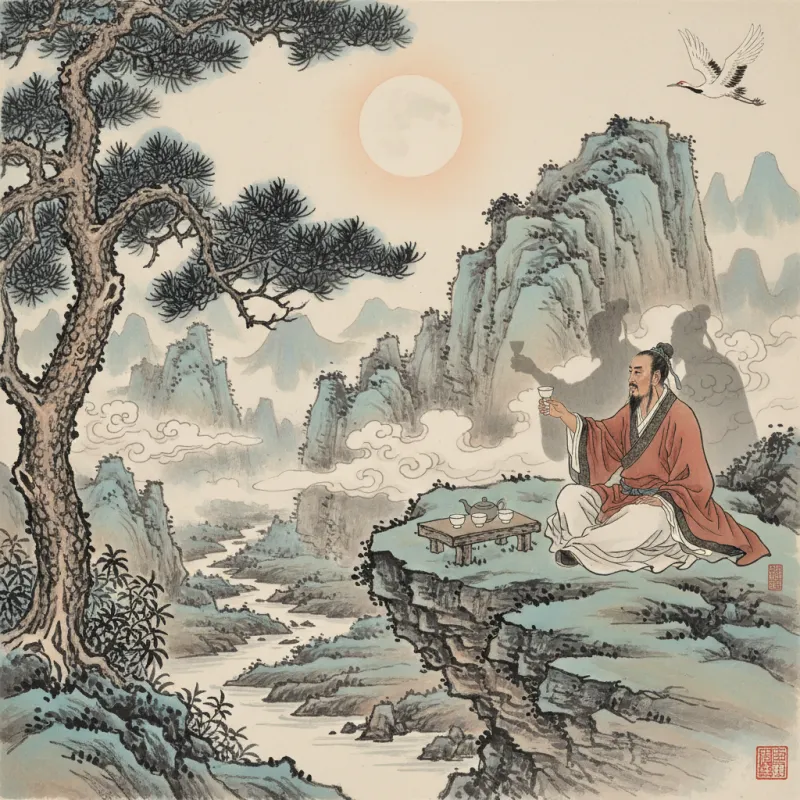
Picture this: a lone figure sits in a moonlit garden, wine jar at his side, raising a cup to the moon itself. No human companions, no servants hovering nearby—just Li Bai (李白, Lǐ Bái), the greatest romantic poet of the Tang Dynasty, getting magnificently drunk with the moon and his own shadow. This isn't loneliness. This is a cosmic party, and you're about to understand why "Drinking Alone Under the Moon" (月下独酌, Yuè Xià Dú Zhuó) remains one of the most audacious poems ever written in Chinese.
The Radical Solitude of a Tang Genius
When Li Bai composed this four-part poem series around 744 AD, he was already famous—and already disillusioned. The imperial court had dismissed him, his political ambitions were crumbling, and the Confucian ideal of serving society seemed increasingly hollow. So what does a genius do when the human world disappoints? He throws a drinking party for celestial bodies.
The opening lines hit you immediately: "Among the flowers, a jug of wine / I pour alone, no friend in sight" (花间一壶酒,独酌无相亲). But here's where Li Bai's brilliance explodes—he doesn't wallow in self-pity. Instead, he elevates the moon and his shadow to the status of drinking companions. This isn't metaphor for the sake of prettiness; it's a philosophical middle finger to conventional society. If humans won't understand him, he'll befriend the cosmos itself.
Moon, Shadow, and Wine: The Unholy Trinity
The poem's central conceit is deceptively simple but philosophically profound. Li Bai invites the moon to drink with him: "I raise my cup to invite the bright moon / My shadow makes us three" (举杯邀明月,对影成三人). Three drinkers: the poet, the moon's reflection in his wine cup, and his own shadow cast by moonlight.
This isn't just clever imagery—it's Daoist philosophy in action. The Zhuangzi (庄子, Zhuāngzǐ), that foundational Daoist text, constantly questions the boundaries between self and other, reality and illusion. Li Bai takes this further: if everything is interconnected in the Dao, why can't the moon be a drinking buddy? His shadow becomes a companion who "follows my body's every move," and the moon "doesn't know how to drink" but keeps him company anyway.
The wine itself functions as the medium of transformation. In Tang Dynasty drinking culture, wine wasn't just alcohol—it was a tool for transcendence, a way to shed social pretenses and access deeper truths. Li Bai, who famously claimed he needed a gallon of wine to write a hundred poems, uses intoxication to dissolve the barrier between human and cosmos.
The Dance of Impermanence
The second section of the poem shifts into movement: "I sing, the moon wanders back and forth / I dance, my shadow tumbles and scatters" (我歌月徘徊,我舞影零乱). This is where Li Bai's romanticism reaches its peak. He's not just sitting and drinking—he's performing for the universe, and the universe responds.
Notice the verbs: the moon "wanders" (徘徊, páihuái), suggesting it's actively engaged, perhaps even uncertain. The shadow "tumbles and scatters" (零乱, língluàn), breaking apart and reforming. Everything is in flux, nothing is fixed. This captures the Buddhist concept of impermanence (无常, wúcháng) that permeated Tang intellectual life, but Li Bai transforms it from a source of suffering into a source of joy.
Compare this to Du Fu's reflective poetry, where solitude often carries weight and melancholy. Li Bai's solitude is ecstatic, almost manic. He's not mourning the absence of human friends—he's celebrating a different kind of communion entirely.
The Sober Morning After (Sort Of)
Then comes the pivot: "While sober, we're happy together / Once drunk, we each scatter apart" (醒时同交欢,醉后各分散). This line has puzzled scholars for centuries. Is Li Bai acknowledging the illusion? Is he admitting that his cosmic companions are just projections of his intoxicated mind?
I'd argue he's doing something more sophisticated. The poem suggests that sobriety and drunkenness offer different kinds of truth. When sober, he can consciously enjoy the companionship of moon and shadow—it's a chosen perspective, a deliberate act of imagination. When drunk, the boundaries dissolve completely, and even these imagined companions scatter because there's no "self" left to perceive them as separate.
This is pure Daoist mysticism. The Daodejing (道德经, Dàodéjīng) speaks of returning to the "uncarved block" (朴, pǔ), a state of undifferentiated unity. Li Bai's drunkenness becomes a path to that unity, where even the distinction between poet, moon, and shadow disappears.
The Eternal Rendezvous
The poem concludes with a promise: "Forever to form a ruthless friendship / Our meeting place: the distant Milky Way" (永结无情游,相期邈云汉). That word "ruthless" (无情, wúqíng) is crucial—it doesn't mean cruel, but rather "without conventional emotion," beyond the petty attachments and disappointments of human relationships.
Li Bai is proposing an eternal bond with the cosmos itself, one that transcends death and earthly concerns. The Milky Way (云汉, yúnhàn, literally "cloudy river") becomes their meeting place—not in some metaphorical afterlife, but in the eternal present of cosmic consciousness. This echoes the Daoist immortals who were said to wander among the stars, free from mortal constraints.
Why This Poem Still Matters
"Drinking Alone Under the Moon" endures because it offers a radical alternative to loneliness. In our hyperconnected age, where social media promises constant companionship but often delivers hollow interaction, Li Bai's solution feels startlingly relevant. He suggests that true connection might not come from accumulating human relationships but from recognizing our fundamental unity with everything that exists.
The poem also challenges our assumptions about what counts as "real." Is the moon really Li Bai's companion, or is he just drunk and talking to himself? Li Bai would say that's the wrong question. In the Daoist worldview, the distinction between subjective and objective reality is itself an illusion. If the moon feels like a companion, if the experience of cosmic communion is genuine, then it is real—perhaps more real than the superficial social bonds that disappointed him at court.
Li Bai's Moonlight Legacy
This poem became the template for countless later works exploring solitude and transcendence. Song Dynasty poets like Su Shi (苏轼, Sū Shì) would return to these themes, though usually with more philosophical restraint. Li Bai's wild, ecstatic approach to cosmic communion remained unique—nobody else quite dared to get drunk with the moon and call it friendship.
The poem also cemented the moon as the supreme symbol in Chinese poetry. While Wang Wei's nature poetry often featured mountains and rivers, Li Bai made the moon his signature image—appearing in dozens of his poems as friend, muse, and mirror. The moon became shorthand for the poet himself: distant, luminous, slightly unattainable, and absolutely unwilling to play by conventional rules.
When you read "Drinking Alone Under the Moon" today, you're not just encountering a beautiful poem about loneliness. You're witnessing a man who refused to accept the limitations of ordinary human existence, who insisted that the universe itself could be his companion, and who found in wine and moonlight a path to something transcendent. That's not escapism—that's a revolution in consciousness, served in a wine cup under the stars.
Related Reading
- Li Bai's Drinking Poems: Wine, Moon, and the Soul of Chinese Poetry
- Bai Juyi: The People's Poet
- Wang Wei: The Poet-Painter of Nature
- Du Fu's War Poems: Witnessing the An Lushan Rebellion
- 10 Greatest Tang Poems Every Reader Should Know
- Poetry Drinking Games: When Literature Met Entertainment
- Exploring the Depths of Chinese War Poetry from Tang to Yuan Dynasties
- Su Shi in Exile: How Banishment Produced China's Greatest Prose
Explore Chinese Culture
- Explore the Tang dynasty's golden age
- Explore Daoist themes in classical poetry
- Explore Chinese literary traditions