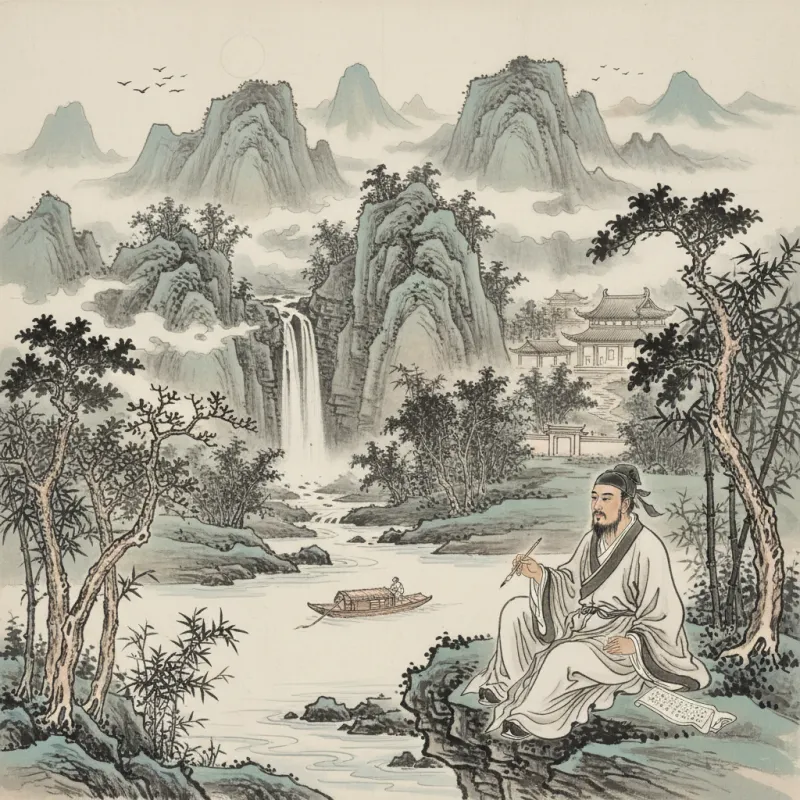
Picture this: a middle-aged official stands alone in his mountain estate as autumn rain begins to fall. Instead of seeking shelter, he watches pine trees darken with moisture, listens to water trickling over stones, and feels something shift inside him—not loneliness, but a profound sense of belonging to the landscape itself. This is Wang Wei (王维, Wáng Wéi, 701–761 CE), and in moments like these, he wasn't just observing nature. He was dissolving into it.
The Man Who Painted With Words and Wrote With Brushstrokes
Wang Wei occupies a unique position in Chinese literary history: he's the only major Tang poet whose paintings were considered equally important as his poetry. The Song Dynasty critic Su Shi (蘇軾, Sū Shì) famously declared, "In Wang Wei's poetry there is painting; in his painting there is poetry." This wasn't mere flattery. Wang Wei literally saw the world differently than his contemporaries, and both his arts emerged from the same contemplative vision.
Born into a scholarly family in Puzhou (modern-day Shanxi), Wang Wei was a prodigy who passed the imperial examinations at twenty-one. But here's what makes him fascinating: despite his early success in the bureaucratic world, he spent much of his career trying to escape it. After his wife died young, he never remarried, gradually retreating into a life split between obligatory government service and his beloved Wangchuan Estate (輞川別業, Wǎngchuān Biéyè) in the Zhongnan Mountains. This wasn't escapism—it was a deliberate choice to live according to Buddhist and Daoist principles that valued simplicity, silence, and direct experience of nature over worldly achievement.
The Wangchuan Collection: A Landscape of the Mind
Wang Wei's most celebrated work is the "Wangchuan Collection" (輞川集, Wǎngchuān Jí), a series of twenty quatrains describing scenes around his mountain estate, created in collaboration with his friend Pei Di (裴迪, Péi Dí). Each poem captures a specific location—Deer Enclosure, Bamboo Lodge, Magnolia Basin—with such visual precision that readers can almost see the paintings that accompanied them (though sadly, the original paintings are lost).
Take "Deer Enclosure" (鹿柴, Lù Zhài), one of his most famous poems:
Empty mountain, no one in sight,
Only the sound of someone talking echoes back.
Returning sunlight enters the deep forest,
Shining again on the green moss.
In just twenty characters, Wang Wei creates a complete sensory experience. Notice what he does: the mountain appears empty, but sound reveals hidden human presence. Then light—that most painterly element—penetrates the forest depths to illuminate moss. The poem moves from absence to presence, from sound to light, from vast to intimate. This is poetry that thinks like painting, organizing space and perception rather than telling a story.
Buddhist Emptiness and the Art of Subtraction
Wang Wei was a devout Buddhist, and his poetry reflects the Chan (Zen) Buddhist concept of emptiness (空, kōng)—not nothingness, but a state where the self dissolves and direct perception becomes possible. Unlike Li Bai's exuberant romanticism or Du Fu's social consciousness, Wang Wei's poetry practices radical subtraction.
Consider "Bird Call Valley" (鳥鳴澗, Niǎo Míng Jiàn):
Man at leisure, osmanthus flowers fall,
Night quiet, spring mountain empty.
Moon rises, startles mountain birds,
Now and then calling in the spring valley.
The human observer is barely present—just "man at leisure" (人閑, rén xián). Everything else is nature moving through its own rhythms: flowers falling, moon rising, birds calling. Wang Wei doesn't impose meaning or emotion on the scene. He simply witnesses it with such clarity that the poem becomes a kind of meditation device, inviting readers into the same state of alert stillness.
This approach was revolutionary. Earlier Chinese poetry often used nature as metaphor for human emotions or political situations. Wang Wei sometimes did this too, but his greatest poems present nature as valuable in itself, worthy of attention for its own sake. This wasn't just aesthetic preference—it was spiritual practice.
The Technique of "Painting With Negative Space"
Wang Wei's poetic technique mirrors the Chinese painting principle of "leaving blank" (留白, liú bái)—using empty space as an active element of composition. His poems are famous for what they don't say. He rarely uses explicit emotional language, yet his poems feel deeply emotional. He seldom describes himself, yet his presence permeates every line.
Look at "Zhongnan Retreat" (終南別業, Zhōngnán Biéyè):
Middle years, quite fond of the Way,
Late in life, made home at South Mountain's edge.
When the mood strikes, I go alone,
This splendid thing, I alone know.
Walking to where the water ends,
Sitting and watching clouds rise.
By chance meeting an old woodsman,
Talking and laughing, no fixed time to return.
The poem's power lies in its casualness—"when the mood strikes," "by chance meeting," "no fixed time." Wang Wei presents spontaneity and freedom as the highest values, but notice the structure underneath: the progression from solitary walking to chance encounter, from water (finite) to clouds (infinite), from purposeful movement to timeless conversation. The apparent artlessness is actually supreme artistry.
Political Turmoil and the An Lushan Rebellion
Wang Wei's life wasn't all mountain retreats and philosophical contemplation. In 755 CE, when he was fifty-four, the catastrophic An Lushan Rebellion (安史之亂, Ān Shǐ zhī Luàn) erupted, nearly destroying the Tang Dynasty. Rebel forces captured Chang'an, and Wang Wei, unable to escape, was forced to serve in the rebel administration. This was considered treason.
When government forces eventually retook the capital, Wang Wei faced execution. He was saved only because his brother Wang Jin offered to sacrifice his own rank to spare him, and because Wang Wei had written poems during the rebellion expressing his anguish at being separated from the legitimate court. The emperor reduced his sentence to demotion.
This episode adds poignant context to Wang Wei's nature poetry. His retreat to Wangchuan wasn't just aesthetic preference—it was refuge from a brutal political world where one wrong move meant death. His poems about emptiness and detachment weren't abstract philosophy but survival strategies for navigating impossible circumstances. The stillness in his poetry was hard-won, not given.
Legacy: The Poet Who Taught Painters to See
Wang Wei founded what later became known as the "Southern School" (南宗, Nán Zōng) of Chinese landscape painting, emphasizing spontaneous expression and spiritual resonance over technical precision. Though none of his original paintings survive, his influence on Chinese art is immeasurable. Later painters studied his poetry to learn how to see, and poets studied accounts of his paintings to learn how to write.
His impact on poetry was equally profound. Wang Wei essentially created the template for Chinese nature poetry that would dominate for the next thousand years. The Song Dynasty poet-officials who retreated to country estates, the Ming Dynasty hermit-painters, the Qing Dynasty scholars writing about gardens—all were following paths Wang Wei first mapped.
What makes Wang Wei eternally relevant isn't just his technical mastery but his fundamental insight: that paying complete attention to the natural world—really seeing a shaft of light on moss, really hearing a bird call in a valley—is itself a form of wisdom. In our age of constant distraction and environmental crisis, his poetry offers something more valuable than nostalgia. It offers a way of being present, of finding depth in simplicity, of recognizing that the most profound experiences often happen when we stop trying to make things happen.
Reading Wang Wei Today
Modern readers sometimes find Wang Wei's poetry too quiet, too understated compared to the dramatic intensity of Li Bai or the emotional directness of Du Fu. But that's precisely the point. Wang Wei asks us to slow down, to notice what we usually overlook, to find significance in the apparently insignificant. His poems are short, but they're meant to be read slowly, even repeatedly, like koans that gradually reveal their meaning.
The best way to approach Wang Wei is to read a poem, then pause and visualize it as a painting. Where would the empty space be? What would be in focus? What would fade into mist? Then read it again, listening for the sounds—water, wind, birds, human voices echoing in valleys. Finally, read it once more and notice your own response. Are you trying to extract meaning, or can you simply rest in the experience the poem creates?
Wang Wei believed that nature itself was the ultimate teacher, and his poetry was simply a way of pointing toward what was already there, waiting to be noticed. In "Bamboo Lodge" (竹里館, Zhú Lǐ Guǎn), he writes:
Sitting alone in the dark bamboo,
Playing the zither and whistling long.
Deep forest, no one knows,
The bright moon comes to shine on me.
Even in solitude, even unknown to others, there's the moon—that perfect image of natural illumination that requires no human witness to exist, yet somehow finds us anyway. That's Wang Wei's gift: showing us we're never truly alone because we're always part of something larger, if only we're quiet enough to notice.
Related Reading
- Bai Juyi: The People's Poet
- Li Bai's Drinking Poems: Wine, Moon, and the Soul of Chinese Poetry
- The Complete Guide to Chinese Classical Poetry: From Tang Poems to Song Ci
- 10 Greatest Tang Poems Every Reader Should Know
- What Is Tang Poetry? A Complete Introduction for English Readers
- Xin Qiji: The Warrior Poet
- Classical Chinese Prose: The Essays That Shaped a Civilization
- Best English Translations of Tang Poetry: A Comparative Guide
Explore Chinese Culture
- Explore the Tang dynasty's golden age
- Explore Daoist themes in classical poetry
- Explore Chinese literary traditions