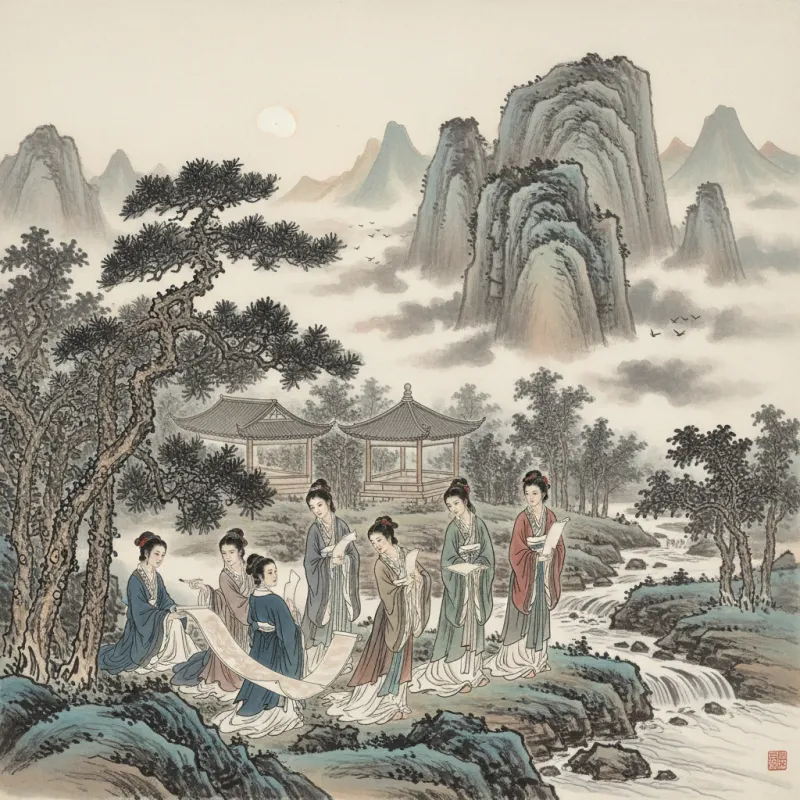
The imperial archives burned in 1127, and with them, thousands of poems by women whose names we'll never know. When the Jin armies sacked Kaifeng, they weren't just destroying a capital — they were erasing voices. The scrolls that survived did so almost by accident: tucked into a scholar's traveling bag, copied by a devoted daughter, or preserved because a male poet happened to quote them. This is how women's poetry survived in China: not through institutional preservation, but through luck, love, and the occasional man who thought a woman's words were worth saving.
The Mechanics of Erasure
The problem wasn't talent. The problem was the anthology system. Chinese literary culture preserved poetry through official collections compiled by male scholars, who selected works for the imperial library, who decided what counted as "serious literature." Women's poetry was categorized as 闺秀诗 (guīxiù shī) — "boudoir poetry" — a diminutive term that marked it as domestic, private, and therefore less important than the public poetry of men.
Consider the numbers: the Complete Tang Poems (全唐诗, Quán Táng Shī), compiled in 1705, contains nearly 49,000 poems by over 2,200 poets. Only 130 of those poets are women. Either Tang dynasty women wrote far less poetry than men — unlikely, given that poetry was a standard part of educated women's training — or their work simply wasn't collected. The anthology tells us more about who had the power to preserve poetry than about who had the power to write it.
Even when women's poetry was preserved, it was often edited. Male editors would "improve" poems by women, smoothing out what they saw as excessive emotion or inappropriate boldness. We know this happened, but we can rarely know which poems were altered and which survived intact.
Li Qingzhao: The Exception Who Proves the Rule
Li Qingzhao (李清照, 1084-1155) is the most famous female poet in Chinese history, and her fame itself is instructive. She survived in the literary record because she was married to Zhao Mingcheng (趙明誠), a prominent scholar and antiquarian who took her work seriously. She survived because she wrote a treatise on 词 (cí) poetry that male scholars found valuable. She survived because she was so undeniably talented that even the male literary establishment couldn't ignore her.
Her early poems, written during her marriage, are remarkable for their frank sensuality. In "Like a Dream" (如夢令, Rú Mèng Lìng), she writes:
"昨夜雨疏風驟,濃睡不消殘酒。試問捲簾人,卻道海棠依舊。知否,知否?應是綠肥紅瘦。"
"Last night, sparse rain and sudden wind / Deep sleep couldn't dispel the lingering wine / I asked the maid rolling up the blinds / She said the crabapple blossoms were unchanged / But don't you know, don't you know? / The green leaves should be plump, the red petals thin."
The poem is ostensibly about flowers after a storm, but it's really about the morning after drinking, about the body's memory of pleasure, about the gap between what the servant sees and what the poet knows. Male poets wrote about wine and hangovers constantly, but they rarely wrote about asking the maid what happened to the flowers. Li Qingzhao writes from inside the domestic space, but she writes with the authority of someone who knows that domestic space is where life actually happens.
After her husband's death and the fall of the Northern Song, her poetry darkened. Her later ci are studies in grief and displacement, like the regulated verse forms that male poets used to write about exile, but with an added layer of gendered vulnerability. A widowed woman in Song China had almost no social power. Li Qingzhao's late poems are about that powerlessness, but they're also about refusing to be silent about it.
The Courtesan Poets
If respectable women's poetry was underpreserved, courtesans' poetry had a slightly better chance — not because courtesans were more respected, but because they performed their poetry publicly. A courtesan who could compose a clever poem on demand was more valuable, so her poems circulated more widely. This is a bitter irony: the women with the least social status sometimes had the most literary visibility.
Xue Tao (薛濤, 768-831) was a Tang dynasty courtesan in Sichuan who became famous enough that she corresponded with major male poets like Yuan Zhen (元稹) and Bai Juyi (白居易). She invented a special small-format pink paper for her poems, which became known as 薛濤箋 (Xuē Tāo jiān) — "Xue Tao's notepaper." About 90 of her poems survive, which is more than most male poets of her era. But we should be clear about what this means: she survived in the record because she was useful to male poets, because she was exotic enough to be interesting, because her story — talented courtesan who almost became respectable — fit a narrative that male scholars found compelling.
Her poem "Sending a Friend" (送友人, Sòng Yǒurén) is typical of her style: technically accomplished, emotionally restrained, and carefully positioned within the conventions of male poetry. She knew that to be taken seriously, she had to write like a man. The tragedy is that we'll never know what she might have written if she'd felt free to write like herself.
The Nüshu Exception
In Jiangyong County, Hunan Province, women developed their own writing system: 女書 (nǚshū), literally "women's script." This phonetic script, used exclusively by women, allowed them to write letters, poems, and songs that men couldn't read. It's the only gender-specific writing system known to have existed.
Nüshu texts are mostly about women's experiences: marriage, friendship between women, grief over daughters who married away. They're written in a seven-character line format similar to classical Chinese poetry forms, but the content is radically different. These are poems about foot-binding pain, about the terror of wedding night, about the bonds between sworn sisters. They're the poems that women wrote when they knew no man would read them.
The script nearly died out in the 20th century. The last fluent writer, Yang Huanyi (阳焕宜), died in 2004 at age 98. Scholars are still working to translate and preserve the texts that survive. What we're recovering is an entire parallel literary tradition that existed outside the male-dominated world of classical Chinese poetry.
What We Lost
The poet Yu Xuanji (魚玄機, 844-868) was executed at age 24 for allegedly murdering her maid. About 50 of her poems survive. She was brilliant, ambitious, and angry about the limitations placed on women. In one poem, she wrote about envying the male candidates taking the imperial examinations — she was smart enough to pass, but women weren't allowed to take the test. Her poems are full of that frustration: the knowledge that she had the talent but not the opportunity.
We have 50 of her poems. How many did she actually write? How many other women wrote poems as good as hers but didn't have the luck to have their work preserved? The question is unanswerable, which is exactly the problem.
Reading What Remains
When we read women's poetry from imperial China, we're reading through multiple layers of distortion: the selection bias of male editors, the self-censorship of women who knew men would read their work, the loss of poems that were too bold or too domestic to be preserved. We're reading the survivors, and we need to remember that survival was not random.
But we should also remember that these poets were not victims. They were artists who found ways to write despite the obstacles. Li Qingzhao didn't write like a man — she wrote like herself, and she was so good that the male literary establishment had to acknowledge her. The nüshu poets created their own writing system rather than accept silence. Even the courtesans who wrote within male-approved conventions were making choices about how to use the limited power they had.
The voices that history almost silenced are still speaking, if we learn to listen for them. Every poem by a woman that survived is a small miracle, and also a reminder of the thousands of poems that didn't. When we read women poets of the Tang and Song dynasties, we're not just reading poetry — we're reading evidence of a literary tradition that existed in the margins, in the spaces that the official record didn't care about. That tradition was always there. We're only now learning to see it.
Related Reading
- Rediscovering Women Poets of the Tang, Song, and Yuan Dynasties
- Zhuo Wenjun: The Woman Who Wrote Her Own Love Story
- The Banana Garden Poetry Club: When Women Took Over Chinese Poetry
- Women Poets of China: The Voices That Were Almost Lost
- Ban Zhao: Scholar, Historian, Poet — The Woman Who Finished China's Greatest History
- Xin Qiji: The Warrior Poet
- Qu Yuan: The First Named Poet in Chinese History
- The Enchantment of Song Dynasty Poets: A Deep Dive into Their Timeless Verses
Explore Chinese Culture
- Explore the Tang dynasty's golden age
- Explore Daoist themes in classical poetry
- Explore Chinese literary traditions